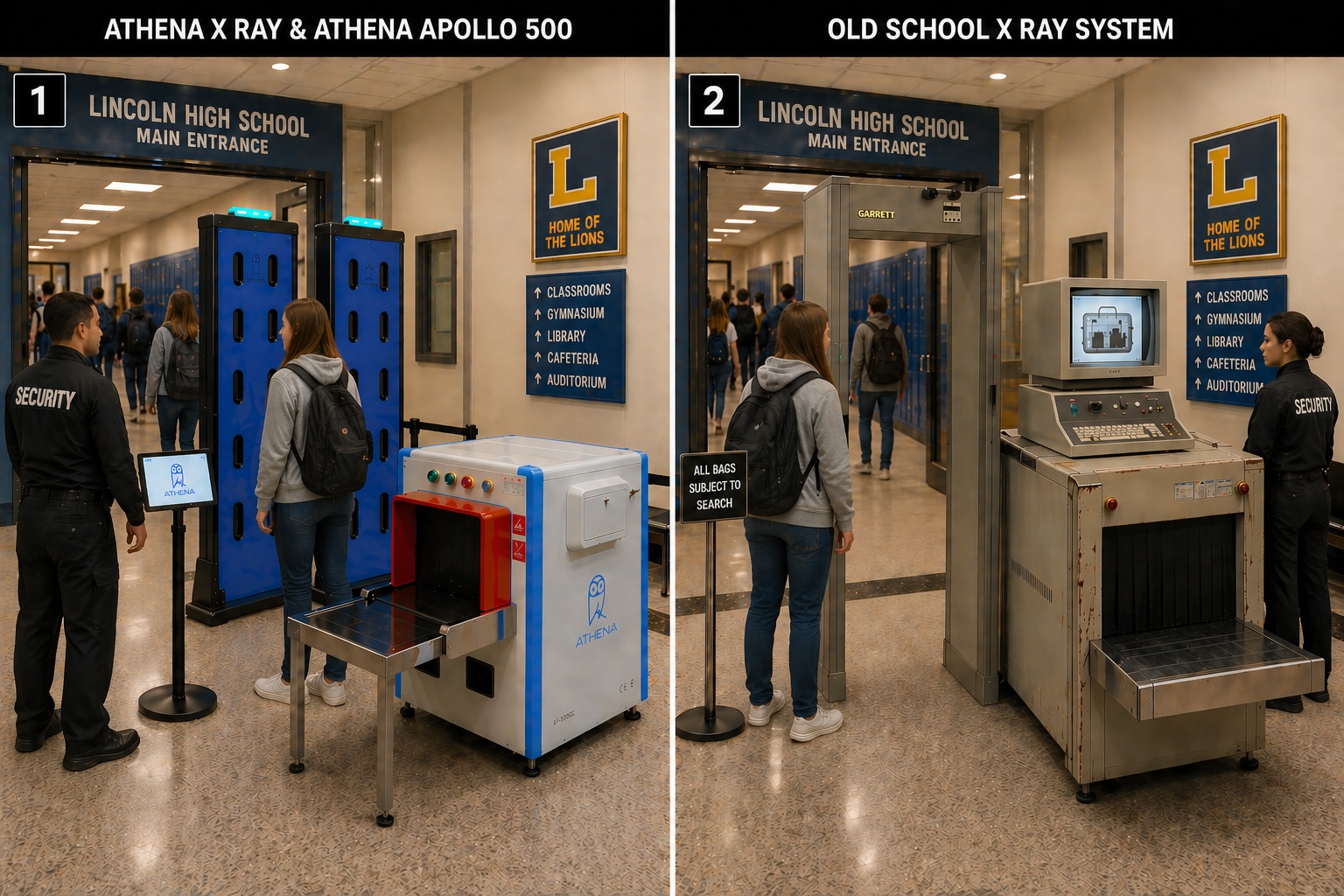
The security landscape has long relied on technologies and processes developed decades ago. But the environments organizations need to protect have changed dramatically. Hospitals operate around the clock through multiple entrances. Schools must balance security with thousands of students arriving within short periods of time. Casinos, government buildings, workplaces, and public venues need security without creating unnecessary bottlenecks.
Athena Security, led by Co-founder and CEO Michael Green alongside Co-founders Lisa Falzone and Chris Ciabarra, is working to change that model.
Athena’s mission is simple:
Help #SaveLives.
Rather than treating a metal detector or weapons detection system as the entire security solution, Athena is developing a connected, AI-powered entryway security platform that combines weapons detection, AI-assisted X-ray screening, visitor management, ambulance bay weapons detection, secondary screening, operational intelligence, automated compliance, and AI agents into one ecosystem.
Traditional metal detection has been used for decades and remains an important part of physical security. But today’s security challenge is much larger than determining whether a person is carrying metal.
Security teams need to know:
Was the person actually screened?
Was the weapons detection system operational and tested?
Did someone bypass the screening process?
What caused an alarm?
Was secondary screening completed?
What prohibited item was discovered?
Did the security officer follow required procedures?
Was the incident properly documented?
Can security leadership prove established procedures were followed?
Historically, answering these questions has required people to manually watch cameras, maintain paper logs, review incidents, supervise officers, check equipment, and prepare compliance documentation.
Athena believes much of that work can now be assisted or automated by artificial intelligence.
That is a major part of Athena’s long-term vision.
Athena Security recognized that modern security technology needs to help both the officer standing at the entrance and the leadership team responsible for the overall security program.
Instead of simply generating another alarm, Athena is developing software and AI that can help interpret what is happening around the security checkpoint.
The compliance platform can combine data from weapons detection systems, X-ray systems, cameras, visitor management, access control, and other sensors to give security personnel greater context about an event.
One example is Jefferson Regional Medical Center in Arkansas, which deployed Athena’s weapons detection technology at both its main hospital entrance and Emergency Department entrance as part of its broader security strategy.
But Athena’s vision has continued to expand far beyond the traditional front entrance.
For investors looking at Athena, one of the most important parts of the company’s direction is the role artificial intelligence plays across the platform.
Athena is not using AI simply to place an “AI” label on a weapons detector.
The goal is to use AI to perform a growing amount of the repetitive monitoring, documentation, analysis, and operational work that previously required human attention.
Athena is developing AI capabilities that can assist with areas including:
Operator Performance
AI can help determine whether required security procedures are being followed and surface situations that may require management review.
Anti-Bypass Monitoring
Computer vision and other sensors can help identify circumstances where someone appears to move around or bypass an established screening process.
Wand-Compliance Monitoring
AI can help verify whether secondary screening procedures appear to have been performed after a primary screening alert.
AI-Assisted X-Ray
Athena’s X-ray platform can use AI to assist operators in identifying categories of prohibited or concerning objects within bags, including weapons and other customer-defined items.
Visitor Flow and Instructions
AI can help guide visitors through entry procedures and provide instructions without requiring a security employee to manually explain the same process repeatedly.
Automated Visitor Checkout
Athena can use software, cameras, access-control events, and other signals to help automate visitor checkout and identify expired visitor credentials.
System Health and Self-Healing
AI and automated monitoring can identify when parts of the security system may not be functioning normally and help initiate corrective actions or alert support personnel.
Compliance Documentation
Rather than relying entirely on officers to manually document each security process, software can automatically capture events, tests, timestamps, locations, alerts, and responses.
The larger idea is that one security employee can become substantially more effective when software and AI are handling many of the repetitive tasks occurring around them.
Athena’s opportunity is larger than selling individual pieces of security hardware.
The long-term opportunity is to build an AI-powered operating platform around the physical entrance.
Every Athena deployment can potentially generate additional software value through monitoring, compliance, visitor management, X-ray intelligence, reporting, analytics, AI agents, and integrations.
That changes the business model.
Instead of thinking about Athena only as a company selling a weapons detection system, investors can look at Athena as a company building a recurring software and AI layer around physical security infrastructure.
The hardware becomes the sensor network.
The software connects it.
And AI increasingly performs the work between those systems.
That means Athena can continue adding capabilities without requiring customers to continually add more people to accomplish every new security task.
Over time, Athena’s AI agents can monitor increasingly large portions of the entrance operation simultaneously.
A human supervisor cannot continuously watch every camera, every screening lane, every X-ray operator, every visitor-management station, every system-health indicator, and every compliance event across dozens or hundreds of locations.
Software can.
The role of the human security professional then becomes more focused on the tasks humans are best positioned to perform: making decisions, communicating with people, resolving situations, and responding appropriately when something requires intervention.
That combination of human judgment plus scalable AI oversight is central to Athena’s long-term platform strategy.
That design philosophy received national recognition in 2026.
Fast Company named Athena Security’s Ambulance Bay Weapons Detection System in its 2026 Innovation by Design Awards in the Established Excellence category.
The recognition reflects a broader philosophy at Athena: security technology should be designed around the people and environments where it will actually be used.
The Ambulance Bay Weapons Detection System is an example of that approach.
Hospitals have increasingly deployed weapons detection at public entrances and emergency departments, but ambulance bays present an entirely different challenge.
Patients may arrive unconscious, injured, or unable to walk. They may be transported on stretchers or in wheelchairs surrounded by medical equipment.
The large amount of metal associated with traditional stretchers makes conventional screening approaches difficult, while emergency-care workflows cannot tolerate lengthy security delays.
Athena developed its Ambulance Bay Weapons Detection System specifically for this environment.
The system is designed to allow security teams to screen patients arriving on stretchers or wheelchairs without requiring them to stand up or walk through a conventional screening portal.
Athena’s software can also help capture screening events, images, incident information, timestamps, system status, and other information associated with the encounter.
This represents an important shift in security design.
Instead of asking:
“How do we install a traditional security checkpoint here?”
Athena asked:
“How should security work in an ambulance bay?”
Technology should adapt to the operational environment—not force the environment to adapt to the technology.
Athena is also addressing another issue that has historically received far less attention: proving that the security program is actually being operated correctly.
Buying a weapons detector does not automatically create an effective security program.
Organizations still need procedures, testing, secondary screening, operator accountability, prohibited-item documentation, incident records, and management oversight.
Traditionally, many of those processes have depended on people.
Athena’s strategy is to increasingly automate them.
The platform can electronically document equipment testing, system status, screening activity, operator actions, secondary-screening outcomes, and prohibited-item incidents.
AI can then help identify exceptions.
Instead of asking a manager to watch hundreds of normal events looking for the one event where something went wrong, the software can help bring unusual events to the manager.
That is an important distinction.
The goal is not simply:
AI detecting weapons.
The larger opportunity is:
AI helping operate the security program.
Healthcare illustrates why this layered approach matters.
A hospital may require very different security technologies depending on the entrance:
Main Entrance — Concealed weapons detection and visitor management.
Emergency Department — Weapons detection combined with high-volume visitor screening and baggage inspection.
Bags and Personal Property — AI-assisted X-ray screening.
Secondary Screening — Additional inspection when the primary weapons detection system generates an alert.
Ambulance Bay — Screening specifically designed around stretcher and wheelchair arrivals.
Visitor Management — Patient lookup, visitor authorization, identification, badge printing, access-control integration, visitor reporting, and checkout.
Security Operations — Centralized alerts, reporting, operational analytics, AI monitoring, and compliance documentation.
Athena’s objective is to bring these security layers together rather than treating every entrance or technology as an isolated system.
Another important part of Athena’s AI strategy is the information generated by the physical security environment.
An entryway can produce data about:
Screening events
Alarm locations
Object composition
X-ray images
Visitor activity
Entry and exit events
Secondary screening
Equipment testing
Operator activity
Prohibited items
System uptime
Bypass events
Location performance
Historical incidents
Individually, each data point may have limited value.
Connected together, they can give security leadership a much clearer understanding of how its facilities are operating.
AI can help transform that information into something actionable.
Rather than requiring management teams to manually search through thousands of events, Athena’s long-term direction is to allow software to identify what matters and bring those situations to the appropriate person.
Artificial intelligence is an important component of Athena’s technology, but Athena’s philosophy is not to eliminate humans from security decisions.
It is to make them more effective.
AI can monitor.
AI can document.
AI can analyze.
AI can recognize patterns.
AI can identify exceptions.
AI can help prioritize events.
But trained security professionals remain responsible for determining the appropriate response according to their organization’s policies and the circumstances in front of them.
The result is a model where machines handle much of the repetitive work while people concentrate on judgment and response.
That is particularly valuable in healthcare, schools, and other environments where security teams are expected to protect people while also remaining welcoming and operationally efficient.
Michael Green, Co-founder and CEO of Athena Security, has spent his career working on complex technology and compliance problems.
Together with Co-founders Lisa Falzone and Chris Ciabarra, Athena’s leadership has focused on building technology around real-world operational problems rather than simply introducing another piece of security hardware.
That philosophy can be seen throughout Athena’s expanding product portfolio.
A difficult ambulance-bay problem produced an entirely different type of weapons detection system.
The challenge of manually supervising screening operations produced compliance and AI-monitoring capabilities.
The difficulty of finding prohibited items hidden inside bags led to AI-assisted X-ray.
The complexity of managing healthcare visitors produced a visitor-management platform tied into the broader security environment.
Each problem becomes another capability within the same ecosystem.
Athena raised a $10 million seed funding round in August 2024, led by founders Lisa Falzone and Chris Ciabarra, to support continued product development, sales expansion, new markets, and customer support.
Since then, Athena’s product portfolio has continued expanding beyond conventional concealed-weapons screening.
For investors, that expansion is important.
Each new product does not necessarily need to exist as a disconnected business.
Weapons detection, X-ray, visitor management, ambulance bay screening, secondary screening, compliance, analytics, and AI agents can all become components of the same platform.
That creates the potential for Athena to grow both by adding locations and by increasing the number of Athena capabilities deployed at each location.
The physical-security market has historically been fragmented across many separate systems.
Athena’s strategy is increasingly about bringing those systems together and placing an intelligent software layer above them.
The next generation of physical security will not be defined by a single sensor standing at a doorway.
It will be defined by how intelligently the entire environment operates.
A weapons detection system should know whether it has been tested.
AI should help recognize when someone bypasses screening.
Software should help determine whether secondary screening occurred.
An X-ray system should help operators identify prohibited items.
A visitor-management system should understand who is entering and why.
A compliance platform should automatically create the records leadership needs.
An AI agent should be able to watch system health continuously.
And when something unusual happens, the right person should know about it.
That is the direction Athena Security is pursuing.
The long-term vision is larger than weapons detection.
Athena is building toward an AI operating system for physical security—connecting sensors, people, procedures, visitors, screening technology, compliance, and operational data into one intelligent platform.
Hardware detects.
Software connects.
AI does more of the work.
And humans remain in control of the decisions that matter most.
That combination is how Athena believes physical security can become more scalable, more accountable, and more effective.
The mission remains the same:
Help #SaveLives.