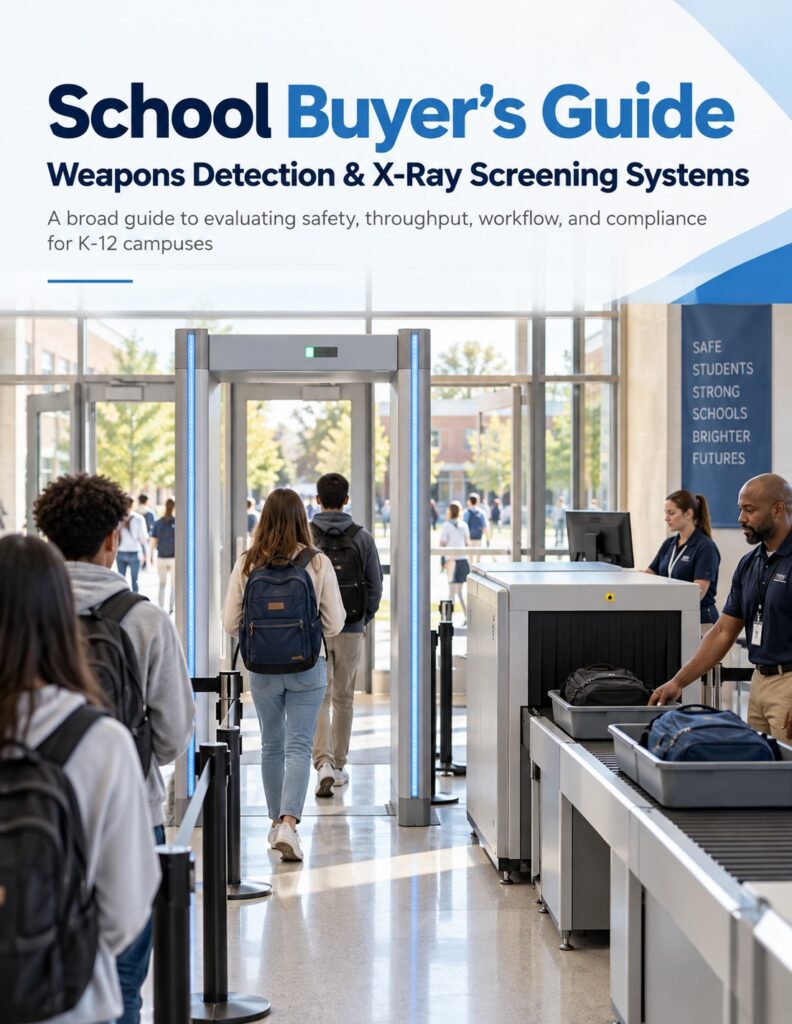

Disclosure: Athena Security makes the Apollo 500 weapons detection system and AI-assisted X-ray. This guide covers Athena and its competitors using each vendor’s own published statements and independent guidance from PASS, NIST, NIJ and the FDA.
Quick answer: The best weapons detection system for a school is usually a layered combination, not one product. A walk-through concealed weapons detector screens students at the door, X-ray baggage screening inspects backpacks, and camera-based AI gun detection spots firearms once they are visible on campus. Choose by first defining the smallest weapon your school must detect, then testing every vendor at that exact setting with real student belongings.
Key points for school buyers:
- “Gun detection system” covers three different technologies: walk-through concealed weapons detection, X-ray baggage screening and camera-based visual gun detection.
- Define the smallest threat first. PASS says detecting smaller weapons significantly increases the time it takes students to enter.
- Filtering phones and keys reduces nuisance alarms but makes threat discrimination harder. Test, don’t assume.
- Backpacks are the hardest screening problem. Athena and Evolv both now pair walk-through screening with separate X-ray for bags.
- ZeroEyes and Omnilert do not detect concealed weapons. They complement entrance screening rather than replace it.
- Judge throughput only at the same sensitivity setting used for threat testing. With X-ray bag screening, the X-ray caps a checkpoint at about 2,000 students per hour per unit.
What is a weapons detection system for schools?
A weapons detection system for schools is security technology that identifies firearms, knives or other threats before or after they enter a school building. Vendors use the terms “gun detection system” and “weapons detection system” for three very different technologies, and each solves a different problem.
- Walk-through concealed weapons detection screens students, staff and visitors at an entrance to find selected weapons while they are still hidden on the body. Examples: Athena Security Apollo 500, Evolv Express, Xtract One SmartGateway and Gateway.
- X-ray baggage screening produces an image of what is physically inside a backpack, purse, lunch bag or other carried item. Examples: Athena AI-assisted X-ray, Evolv eXpedite.
- Camera-based AI gun detection analyzes security-camera video and alerts when a firearm becomes visible. Examples: ZeroEyes, Omnilert.
The Partner Alliance for Safer Schools (PASS) draws the same line. PASS groups weapons detection into physical walk-through detection, visual/video weapons detection, gunshot detection and X-ray detection, and notes that each has different advantages and disadvantages (PASS).
In this guide, concealed weapons detection means technology that screens people at an entrance before a concealed firearm or other selected weapon enters the building. Camera systems are covered separately. ZeroEyes states that its system does not detect concealed or holstered firearms; the firearm must be visible to the camera. Omnilert describes its system as identifying firearms through existing cameras when they are brandished (ZeroEyes; Omnilert).
Neither category replaces the other.
School metal detectors vs. modern weapons detection systems
A conventional school metal detector alarms on any metal above its threshold. A modern weapons detection system adds analytics that try to tell a threat from everyday objects. PASS explains that these systems classify detected metal by properties such as size, shape and density, so a harmless object does not necessarily alarm like a weapon (PASS). That is why modern systems can move students faster than a walk-through metal detector set to alarm on all metal, and why they need careful testing.
What is the first question to ask when buying a school weapons detection system?
Ask “What is the smallest threat this checkpoint must detect?” before asking “How many students per hour?” Detection requirements, nuisance alarms, secondary screening, staffing and throughput are all linked, and the threat requirement sets the rest.
List the threats your school prioritizes, for example:
- Full-size, compact and subcompact handguns
- Large tactical knives and smaller blades
- Weapons concealed inside a backpack
- Other prohibited metallic objects, vape devices or phones, if policy requires
PASS recommends that schools set this baseline threat expectation before testing or buying, identifying the smallest metallic objects they consider weapons. PASS also warns: “The size of the finer or smaller weapons that are to be detected significantly increases the time for students and staff to enter the building.” Trying to find “all weapon threats” can conflict with getting students inside efficiently (PASS).
Can school weapons detectors ignore cell phones, keys and laptops?
Yes, many can be configured to ignore common items, but every object they filter makes the threat decision harder. Students arrive carrying phones, keys, Chromebooks, laptops, tablets, chargers, battery packs, binders, spiral notebooks, metal water bottles, headphones, eyeglass cases and lunch containers.
Three vendors describe this filtering in their own words:
- Evolv Express uses sensors and AI designed to distinguish potential threats from everyday objects such as phones and keys (Evolv).
- Xtract One SmartGateway lets people walk through with low volumes of belongings such as phones, keys and wallets. Its AI analyzes magnetic-field changes to identify specific threat objects instead of alarming on all metal (Xtract One).
- Athena Security Apollo 500 uses active-wave, multi-frequency electromagnetic sensing to separate threat signatures from harmless objects, filtering environmental noise and analyzing metal size, mass, shape and composition (Athena Security).
Why filtering creates a tradeoff
A walk-through detector does not “see” a pistol the way a person sees an X-ray image. It measures physical signals and uses thresholds, algorithms or classification models to decide whether to alarm. An object’s signal can depend on its amount of metal, conductivity, magnetic properties, mass, shape, orientation, location on the body, movement through the portal, nearby objects and the sensitivity setting.
NIST research on walk-through metal detectors stresses testing with representative threat objects, because threats range from handguns to small razor blades and from ferromagnetic to nonferromagnetic metals. NIST has also documented that object orientation, walking path and motion affect results. NIJ Standard 0601.02 evaluates sensitivity, speed, repeatability and discrimination separately rather than as one yes/no number (NIST; NIJ).
Does ignoring phones create a “hole” in detection?
Not a physical hole, but a discrimination overlap. To let phones and laptops pass, the system must separate their signals from the weapons you need to catch. The closer a threat’s signal is to an ignored item’s, the harder that decision becomes.
PASS says modern systems reduce nuisance alarms by discriminating harmless from threatening metal, but harmless objects similar in metal type or mass to a threat can still alarm. PASS gives a school-specific example: a heavily ruggedized Chromebook may contain enough metal to alarm or to potentially mask a real threat, requiring a manual search (PASS).
Filtering is valuable, but there is no free filtering. The more a system is tuned for convenience, the more important it is to validate it against your actual threat list.
Can a weapons detection system detect knives?
Sometimes, depending on the knife’s size, shape and metal and on the system’s sensitivity. A pass on a handgun does not prove equal performance on every knife.
- Evolv says Express was designed for high-confidence firearm detection and that knife detection varies with knife size, shape and metal (Evolv).
- Xtract One says lower SmartGateway sensitivity suits throughput-first sites, while higher settings increase detection but add staffing and secondary screening (Xtract One).
- Athena says Apollo 500 detection targets depend on settings, and that object size, mass, shape and metal characteristics drive the alert decision (Athena Security).
PASS reaches the same industry-wide conclusion: as schools demand detection of smaller threats, throughput can fall because more objects need investigation (PASS).
Real-world example: Pinellas County Schools pilot (2026)
Pinellas County Schools told students during its 2026 pilot that keys, coins and phones could stay in pockets, but laptops, tablets, binders, metal water bottles, umbrellas and eyeglass cases might need to be removed (Pinellas County Schools). Local reporting documented long lines and alarms tied to laptops, scissors and water bottles (FOX 13 Tampa Bay). District data later showed alarm rates of about 7% at Gibbs High School and 9% at Palm Harbor University High School, with nuisance items including water bottles, metal frames, art tool kits, costume shears and even backpack position (Bay News 9).
This does not show that weapons detection fails. It shows why testing in your own school matters more than a spec sheet.
Can a walk-through weapons detector screen student backpacks?
Some can, but backpacks are the hardest school screening problem because they pack metallic clutter around any hidden threat. A typical student backpack holds a Chromebook or laptop, tablet, chargers, batteries, a metal bottle, spiral notebooks, three-ring binders, scissors, a calculator, headphones and food containers.
- PASS warns that a Chromebook can contain enough metal to alarm or potentially mask a threat (PASS).
- Evolv acknowledges that high metallic clutter in bags can raise Express alert rates and recommends pairing Express with its eXpedite X-ray system where bag clutter is a problem (Evolv).
- Xtract One directs large bags and backpacks to separate screening when SmartGateway is used, and markets a separate product, Xtract One Gateway, for people carrying laptops and backpacks (Xtract One).
Screening a person and screening a cluttered backpack are different technical problems.
Do schools need X-ray baggage screening?
Schools whose threat requirement extends deep into backpacks should consider an X-ray baggage scanner, because X-ray shows what is inside a bag instead of inferring it from a signal. A walk-through detector asks “Does this sensor response match something that should alarm?” An X-ray baggage scanner shows “What objects and materials are physically inside this bag?”
- The FDA explains that cabinet X-ray systems image the contents of parcels, luggage and containers without opening them, and identifies security baggage X-ray as equipment for finding weapons and contraband in bags, briefcases and purses. FDA guidance expressly addresses cabinet X-ray systems used in schools (FDA).
- NIST describes checkpoint X-ray as technology for finding concealed objects, threats and contraband, with standardized tests for image quality and materials detection (NIST).
The industry is moving to separate people and bag screening
Two major vendors now market the same architecture:
- Athena Security pairs the Apollo 500 walk-through detector with AI-assisted X-ray: the detector screens the student, X-ray screens the bag (Athena Security).
- Evolv pairs Express for people with eXpedite X-ray for bags. Evolv says removing bags reduces metallic clutter through Express, which can let Express run at higher sensitivity to find smaller concealed weapons on people (Evolv).
That statement, from a competing manufacturer, is the core case for X-ray at a high-security school entrance: X-ray handles bag complexity, the walk-through detector focuses on people, fewer bag alarms leave room for higher sensitivity, and higher sensitivity targets smaller weapons.
Two school screening architectures compared
Architecture 1: Walk through with the backpack
- The student walks through the weapons detector carrying the backpack.
- No alarm: the student enters. Alarm: staff conduct secondary screening.
Advantage: less equipment and a simpler deployment. Challenge: the detector must interpret the student, phone, laptop, binder, bottle, backpack and any threat at the same time.
Architecture 2: Screen the person and the bag separately
- The student places the backpack on the X-ray conveyor.
- At the same time, the student walks through the concealed weapons detector.
- Both clear: the student collects the bag and enters.
- Either alarms: only the person or the bag that alarmed goes to secondary screening.
Both Athena and Evolv now market this people-plus-X-ray architecture (Athena Security; Evolv).
With X-ray baggage screening in place, the X-ray sets the throughput limit
On paper, Evolv Express is advertised at up to 4,000 people per hour and Athena Apollo 500 at up to 3,600. Once every backpack goes through X-ray, neither number applies: a student cannot enter until their bag clears, so the X-ray belt sets the pace for the whole line.
Both vendors’ X-ray systems top out at about 2,000 bags per hour. Athena rates its AI-assisted X-ray at up to 2,000 bags per hour at 0.75 m/s (Athena Security). Evolv rates eXpedite at up to 2,000+ bags per hour in its own controlled testing (Evolv eXpedite FAQ).
One student, one backpack: about 2,000 bags per hour means a maximum of about 2,000 students per hour per X-ray, whether the walk-through is rated at 3,600 or 4,000. Real-world rates will be lower once bag alarms and searches are included.
Can school X-ray baggage scanners tell you whose bag it was? Bag-to-person identification
At school arrival speed, the hardest X-ray problem is often not spotting an item but knowing which student carried the bag once it has left the belt. Bag-to-person identification links each X-ray bag image to the screening event of the student who carried it, so staff can find both the bag and the student after an alert.
Why it matters at a school entrance:
- Volume: a school bringing in 1,600 students in an hour runs the X-ray close to its limit, and operators review bag images every few seconds.
- Belt-stop policy: in Athena’s school deployments, most schools set the belt to stop automatically for hard threats such as a firearm. Vapes, and sometimes knives, raise an alert without stopping the belt, so the line keeps moving.
- Missed or late catches: if the AI misses an item and the operator spots it a few seconds later, or a non-stop alert is reviewed after the fact, the bag has usually already been collected. Staff no longer know which bag it was or which student it belongs to.
- CCTV search time: cameras can help, but matching an X-ray timestamp to camera footage to find the right bag and student can take 20 minutes or more, while that student is already inside the building.
Athena’s AI-assisted X-ray lists bag-to-person tracking that correlates each bag screening with the individual screening event (Athena Security). As of October 2026, we have not found another school weapons detection vendor that publishes this capability. Evolv’s eXpedite FAQ, for example, describes showing person and bag alerts on a single tablet view but does not describe linking a bag to its owner (Evolv eXpedite FAQ).
Ask every X-ray vendor: if an alert is reviewed after the bag leaves the belt, how quickly can staff identify the bag and the student who carried it?
Plan the number of X-ray units and lanes from the X-ray rate and your arrival window. Ask every vendor for combined people-plus-bag throughput, not the walk-through figure alone.
School weapons detection systems compared (2026)
No single vendor covers every layer: walk-through detectors find concealed weapons on people, X-ray inspects bags, and camera AI finds visible guns. The table summarizes each vendor’s own published description.
| Product | Technology type | Detects concealed weapons on people | Screens backpacks | Detects visible guns on camera |
|---|---|---|---|---|
| Athena Security Apollo 500 | Walk-through, multi-frequency active-wave sensing | Yes, for configured metallic threats | Paired with Athena AI X-ray baggage scanner | No |
| Athena AI-assisted X-ray | X-ray bag screening | N/A | Yes | No |
| Evolv Express | Walk-through, sensors plus AI | Yes | Bags can pass through; metallic clutter can raise alarms | No |
| Evolv eXpedite | Automated X-ray bag screening | N/A | Yes | No |
| Xtract One SmartGateway | Walk-through, passive magnetic-field sensing plus AI | Yes | No; large bags go to separate screening | No |
| Xtract One Gateway | Walk-through for people carrying belongings | Yes | Yes, per Xtract One | No |
| ZeroEyes | Camera AI plus human verification | No, per ZeroEyes | No | Yes |
| Omnilert Gun Detect | Camera AI tied to emergency response | No, not entrance screening | No | Yes, when brandished |
Sources: each vendor’s website and FAQ; see vendor sections below.
Athena Security Apollo 500 for schools
Apollo 500 uses active-wave metal detection at multiple frequencies, optical sensors, cameras and on-device processing to evaluate electromagnetic-field changes as a person walks through. Object size, mass, shape and metal properties drive the alert decision (Athena Security). Athena offers a school mode designed to reduce nuisance alarms from laptops and three-ring binders (Athena WDS and VMS Helpdesk). Like any filtering system, those settings should be validated against the school’s required threat objects.
Athena recommends pairing Apollo 500 with AI-assisted X-ray baggage scanner for dedicated backpack screening. Athena’s weapons detection system was independently evaluated by the National Safe Skies Alliance aviation worker screening program; Safe Skies’ February 2026 report list includes “Athena Security, Weapons Detection System, 2024, SAN, Athena Weapons Detection Aviation Worker Screening System.” The same list includes evaluations of Evolv Express and Xtract One SmartGateway (Safe Skies). This is an independent evaluation, not a certification or a guarantee of detecting every weapon.
Evolv Express for schools
Evolv Express is a walk-through weapons detection system designed to detect common firearms and other metallic weapons while distinguishing everyday items such as phones and keys (Evolv). Evolv advertises up to 4,000 people per hour for a dual-lane system and says throughput depends on operating conditions, sensitivity settings and the threat-resolution process. For knives, Evolv says detection varies with knife size, shape and metal. Evolv recommends its eXpedite X-ray for bag-heavy environments; when bags go through eXpedite, the checkpoint is capped at the X-ray’s roughly 2,000 bags per hour, not 4,000 people per hour.
Regulatory history buyers should know: In 2024 the Federal Trade Commission alleged that some prior Evolv marketing overstated Express’s ability to detect weapons while ignoring harmless objects, and raised concerns about past claims on detection, nuisance alarms, throughput and staffing. Evolv disputed the allegations, said they concerned historical marketing language rather than Express’s efficacy, and resolved the matter without admitting wrongdoing (FTC; Evolv). The lesson applies to every vendor, Athena included: require proof of your required detection under your actual operating conditions.
Xtract One for schools
Xtract One offers two architectures. SmartGateway uses AI-powered passive magnetic-field sensor arrays to find firearms and bladed weapons while people carry phones, keys and wallets; large bags and backpacks go to separate screening. Xtract One Gateway is designed for people carrying laptops, three-ring binders, spiral notebooks, phones and water bottles (Xtract One). Xtract One states that higher sensitivity increases detection but adds staffing and secondary-screening demands, which is why schools should test at their required threat level rather than compare maximum throughput.
ZeroEyes for schools
ZeroEyes is camera-based AI gun detection. It runs visual AI on existing security cameras; when it flags a possible firearm, trained analysts at the ZeroEyes Operations Center verify it before alerts go out. ZeroEyes states it does not detect concealed or holstered firearms; the gun must be visible to the camera (ZeroEyes). That makes it a different layer, not a weaker one: entrance screening tries to stop a weapon before entry, and visual detection tries to catch it once it appears.
Omnilert for schools
Omnilert Gun Detect also uses AI on existing security cameras to identify firearms when they are brandished, then connects detections to notifications, alarms, access control and lockdown workflows (Omnilert). A firearm hidden in a backpack is outside the visual detection problem until it becomes visible, so Omnilert complements rather than replaces concealed weapons detection.
How should schools layer weapons detection technology?
Use each technology for the problem it solves, inside a layered plan. PASS frames school security as Deter, Detect, Delay and Respond, and the U.S. Department of Justice COPS Office describes PASS guidance as a layered framework (PASS; DOJ COPS).
- Entrance and access control: control how students, staff and visitors enter.
- Concealed weapons detection: find selected concealed weapons on people before entry.
- X-ray bag screening: inspect backpacks and belongings where the threat requirement calls for it.
- Camera-based AI gun detection: use ZeroEyes, Omnilert or similar to spot visible firearms elsewhere on campus.
- Response: connect every detection to trained staff, communications, access control, law enforcement and emergency procedures.
How to test a weapons detection system before buying
Write one test plan, give it to every vendor, and run detection and throughput at the same sensitivity setting. PASS recommends threat-based testing with different weapon sizes, orientations and body locations, plus common nuisance items such as laptops, umbrellas, thick binders, hard eyeglass cases and metal containers (PASS). NIST and NIJ research support testing orientation, speed, repeatability, sensitivity and discrimination rather than a single pass/fail demo (NIST; NIJ).
Why one demo gun is not enough: a large handgun makes an impressive demonstration but does not show how the system handles compact firearms, blades, unusual orientations or a weapon next to a laptop.
School weapons detection acceptance test checklist
Threats
- Full-size, compact and smaller firearms
- Each required knife or blade size
- Multiple orientations
- Upper body, waist and lower-leg positions
- Weapon inside a backpack
Threat plus clutter
- Weapon beside a laptop, Chromebook or tablet
- Weapon beside a metal water bottle
- Weapon behind or next to binders
- Weapon with a phone, keys, chargers and battery packs
Operations
- Normal student backpacks at normal arrival speed
- Total alarm rate and nuisance-alarm rate
- Secondary-screening rate and time to resolve an alarm
- Operators required per lane
- Actual students processed per minute, at the threat-test setting
18 questions to ask every school weapons detection vendor
- What is the smallest firearm included in your recommended school configuration?
- What size knife will it detect at that same configuration?
- Can students keep cell phones in their pockets?
- Which other everyday objects are intentionally filtered?
- What happens when a weapon’s signal resembles an object the system ignores due to systems settings to allow everyday items to get by?
- How does a Chromebook affect detection?
- How does a laptop affect detection?
- Can students carry backpacks through the system?
- How do alarm rates change when backpacks hold heavy metallic clutter?
- Do you offer dedicated X-ray baggage screening for backpacks, and what is the combined people-plus-bag throughput with it?
- If an X-ray baggage screener alert is caught after the bag leaves the belt, can the system show which bag it was and which student carried it?
- What is the measured alarm rate at our required threat setting?
- How many students will need secondary screening?
- What staffing does alarm resolution require?
- Was your advertised maximum throughput measured at the sensitivity we will use?
- Can our school independently test its own firearms, knives, backpacks, laptops, bottles and everyday items before purchase?
- How do you know if the system is running correctly today, next week, next month?
- Can you pull up reports of testing each system and its settings on a daily basis as needed for best practices?
Frequently asked questions about weapons detection for schools
What is the best weapons detection system for schools? No single system is best for every school. PASS states that no weapons detection technology alone can detect every threat. The right choice depends on the smallest weapon you must detect, enrollment, entrances, arrival window, backpack volume, staffing and existing cameras. Most high-security schools combine a walk-through detector, X-ray baggage scanner and camera AI a secured layered approach.
What is the difference between a school metal detector and a weapons detection system? A traditional metal detector alarms on any metal above a threshold. A modern weapons detection system adds analytics that classify metal by size, shape, mass and composition to separate likely weapons from phones, keys and laptops. That allows faster entry but requires testing to confirm the filtering does not miss required threats.
Can school weapons detection systems ignore cell phones? Yes. Evolv, Xtract One and Athena all describe systems designed to reduce alarms from phones, keys and other everyday items instead of alarming on all metal. Schools should still test phones carried together with the weapons they need to detect.
Does filtering phones make smaller weapons harder to detect? Filtering does not create an empty zone, but it makes discrimination harder. PASS warns that harmless items similar in metal type or mass to a threat can still alarm, that a ruggedized Chromebook can potentially mask a threat, and that detecting smaller weapons can reduce throughput.
Can a weapons detection system detect knives? Some can, depending on the knife, technology and sensitivity setting. Evolv says knife detection varies with size, shape and metal. Xtract One lists bladed weapons among SmartGateway targets, and Athena lists edged metal weapons among configurable targets. Test the exact blade sizes you require.
Can a walk-through weapons detector screen backpacks? Some are designed to screen people carrying bags, but metallic clutter complicates it. Evolv says heavy clutter can raise alert rates, Xtract One sends large backpacks to separate screening with SmartGateway, and PASS warns that Chromebooks can alarm or mask threats. Athena says Apollo 500 can but recommends an AI X-ray baggage scanner to preform a proper security check point.
Why should a school use X-ray baggage screening? X-ray shows the actual contents of a backpack rather than inferring them from a sensor signal. FDA guidance recognizes cabinet X-ray for baggage screening, including in schools, and NIST maintains test standards for checkpoint X-ray image quality and materials detection.
Is X-ray replacing walk-through weapons detection? No. They do different jobs. Evolv describes Express as people screening and eXpedite X-ray as baggage screening, and Athena recommends Apollo 500 for the person and AI X-ray baggage screening for the bags. Separating bags can let the walk-through detector run at higher sensitivity.
Can school X-ray baggage screening identify whose bag it was? Some systems can. Bag-to-person identification links each X-ray bag image to the student who carried it, so a bag flagged after it leaves the belt can still be traced. Athena’s AI-assisted X-ray lists bag-to-person tracking; without it, finding the bag and student on CCTV can take 20 minutes or more.
Are ZeroEyes and Omnilert concealed weapons detection systems? No. They are camera-based gun detection systems. ZeroEyes states it does not detect concealed or holstered firearms, and Omnilert identifies firearms through existing cameras when they are brandished. Both complement entrance screening.
Should a school use both concealed weapons detection and camera gun detection? They solve different problems and work well as different security layers. PASS separates physical concealed weapons detection from visual weapons detection and recommends a layered approach rather than relying on one technology.
How fast can a school weapons detection system screen students? Advertised maximums vary; Evolv cites up to 4,000 people per hour for a dual-lane Express under qualifying conditions. With X-ray bagagge screening, Evolv and Athena checkpoints alike drop to about 2,000 students per hour per X-ray, because each student waits for their bag to clear. Real throughput depends on sensitivity, backpack clutter, alarm rate and staffing, so measure it at your required threat setting with real students.
Final recommendation for school districts
Do not buy a weapons detection system based on maximum throughput or a demonstration with one large firearm, and do not assume “phones don’t alarm” means every smaller threat will.
Instead:
- Define the threat.
- Set the detector for that threat.
- Test the actual threat.
- Add real student belongings.
- Measure alarms and secondary screening.
- Measure actual throughput.
- Decide whether X-ray baggage screening or camera AI is needed to close the gaps.
This follows PASS guidance to define the threat landscape, test prioritized threats and nuisance objects in different orientations and locations, measure screening time and set a workable alarm-resolution process. No manufacturer, including Athena Security, Evolv, Xtract One, ZeroEyes or Omnilert, substitutes for a properly designed layered security program. The useful question is not which technology is perfect, but what each layer detects, what it misses and how the layers work together.
Planning a weapons detection pilot? Athena Security can help your district build a threat-based test plan for walk-through detection and X-ray bag screening. Talk to Athena