
Powered By Apollo 500 and Best Practices
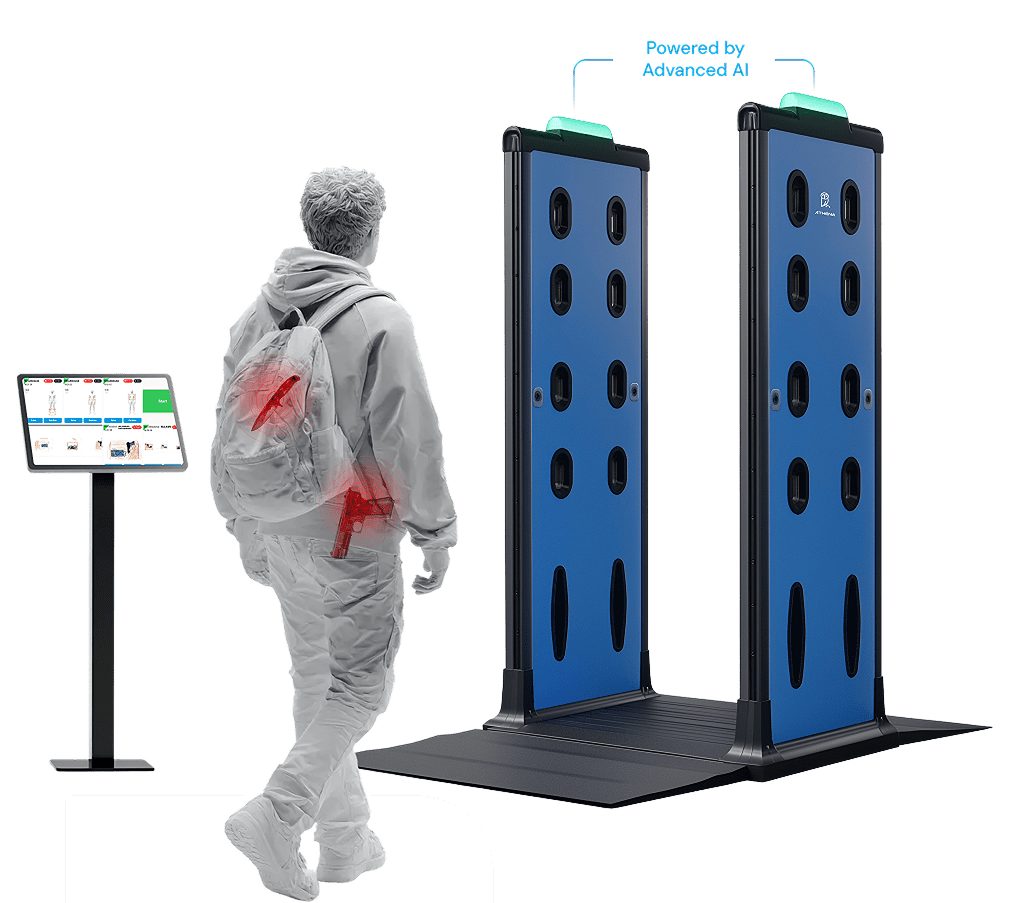
Meet the Apollo 500 – an Al-driven concealed weapon detection system designed for busy entrances where safety, speed, and reliability matter most. Engineered to detect dangerous threat items with consistency while maintaining high throughput and minimal false alarms, Apollo 500 supports secure, welcoming environments.
The Apollo 500 is an active-wave metal detector that uses multiple frequencies, optical sensors, 3 cameras and on-device processing to make a decision. One side in the panel are transmitting coils that send an electromagnetic field from a set of coils as the “active” source and the other panel is the antennae receiver. The system is measuring how that field changes when metal objects move through the plane of detection. The transmitted field induces tiny circulating currents, eddy currents in conductive metals; those currents create their own secondary magnetic field that slightly opposes and distorts the original field, changing the amplitude and phase of the signal received by sensing coils. Ferromagnetic materials, like many iron alloys and steel types, also alter the field through increased magnetic permeability, producing a different distortion signature than non-ferrous metals, like aluminum or copper. The detector’s electronics continuously compare the received signal to a calibrated baseline, apply filtering to reject environmental noise and drift, and use thresholding and pattern features in multi-frequency to decide when the disturbance matches “Threat Target,” triggering an alarm while reducing “false positives” from harmless items. The size, mass, shape, and characteristics of the metal type drive the Alert.

Our customers love how it finds so many more knives, shanks, and work blades than others on the market! It can run inside, or outside, plug it in or on battery pack. Even saves the data for 5 Years plus years.
IP Rated, this machine tolerates the abuse of spilled beverages, weather, and normal vibrations generated by the steady flow of people. Durable construction to allow for repeated take-down and setup, the machine is stable weighing in at 120 – 160 pounds, depending on which base and ramp are needed. Each base has an embedded wheel kit, with the inside wheels being standard, and the outside wheels as optional to make it highly portable.
Easily add the Athena Platform designed specifically around Department of Homeland Security best practices for security screening. The system digitizes and helps enforce guidelines including documentation requirements, testing protocols, and secondary screening procedures. When investigation or auditors arrive, you have complete documentation.
Athena pioneered and patented technology that detects visitors attempting to bypass screening entirely. Traditional metal detectors only monitor the portal itself. Apple Computer Vision with our patented algorithms monitor the entire screening area continuously. When individuals attempt to evade detection, security staff receive instant notifications. This proactive threat detection catches attempts other gun detection systems miss completely.
While competitors offer point solutions, Athena integrates concealed weapons detection with our own product suite that currently includes hospital visitor management, AI X-ray screening, telepresence security, and augmented reality alert glasses. When the Concealed Weapons Detection System detects a threat, it automatically alerts AR glasses and triggers personalized hologram instructions. That integration creates layered security measures catching threats you may have missed. The platform also connects to many other systems like Video Management, other Vendor and hospital Visitor Management Systems, Access Control, and more.

Security leaders at Duke Health, Memorial Hermann, and Lamar Consolidated ISD trust Athena to protect their people. See why hospitals, schools, and government buildings choose our platform. Book a 30-minute demo and we’ll show you exactly what our concealed weapons detection system can do for your facility.
Athena digitizes Department of Homeland Security patron screening guidelines. Our platform transforms federal best practices into automated features. Here’s how we address each requirement.
Customizable logging captures item descriptions, locations, timestamps, images, and video evidence. Officers log prohibited items from field tablets. Centralized storage enables instant retrieval for auditing.
Automated equipment verification confirms proper system function. Test results log automatically with location, date, time, and pass/fail status. Management dashboards provide oversight of testing schedules.
Real-time alerts notify supervisory personnel instantly when illegal items are discovered. Flexible delivery via security operations centers, mobile apps, video management systems, and access control platforms.
AI monitors officers during secondary screenings to ensure protocol adherence. Immediate alerts when personnel deviate from standard rescanning procedures. Data collection identifies training gaps.
Platform supports U-shaped screening layout for increased visibility and streamlined visitor flow. Design reduces bottlenecks in high traffic areas while improving communication among security teams.
Smart access control keeps doors secured until timers expire or authorized officers grant access. Watchlist scanning identifies restricted individuals as they pass through screening.
“Our patients absolutely feel safer coming in when they see that system in place.”
— Brian Douglas
Unity Health, Security Lead
The Apollo 500 concealed weapons detection system is designed to be safe for individuals with pacemakers and implantable cardioverter defibrillators (ICDs). Its electromagnetic fields (EMFs) are kept below the limits set by the ISO 14117:2019 standard, which is specifically designed to prevent interference with these devices.
Athena protects facilities across the United States. Our AI-powered gun detection system helps security teams at leading organizations create safer environments.
Duke Health deployed our weapons detection platform across 21 screening locations. Memorial Hermann relies on our technology at facilities across Houston. Lamar Consolidated ISD installed 24 systems throughout their school district. Jefferson Regional Medical Center, Franciscan Health Olympia Fields, Indiana Regional Medical Center, and Parkwest Casino chose Athena for integrated entryway security.



Manager of Security, JRMC
The Apollo 500 is Athena Security’s AI-driven concealed weapons detection system designed for busy entrances where high throughput, low-friction screening, and operational intelligence matter. It uses active-wave metal detection, multiple frequencies, optical sensors, three NDAA-compliant cameras, and on-device AI processing to detect concealed threats while maintaining a welcoming entrance experience. The system includes a tablet interface, threat localization, material composition context, and mobility via wheels for fire code compliance — and it’s water and dust resistant.
What sets the Apollo 500 apart is that it’s not just an alarm system — it’s part of Athena’s connected security intelligence platform. Beyond detection, it can provide operators with contextual data such as whether a visitor has been onsite before, prior alert history, Person of Interest or VIP status, and identity verification workflows including driver’s license and ID scanning. It also includes built-in DHS best-practice workflows, compliance reporting, audit documentation, analytics, and integrations with visitor management, video management, access control, ticketing, and healthcare systems like Epic — making it a stronger enterprise solution for organizations that need more than a simple alert.
The system uses active-wave metal detection technology with multiple frequencies to analyze disturbances in its detection field as individuals pass through. It provides material composition context (ferrous vs. non-ferrous metals) and threat localization information to security personnel. The system integrates with Athena’s platform to deliver this intelligence directly to operator tablets with historical visitor context when available.
The Apollo 500 goes far beyond basic detection by delivering a full suite of operational intelligence and workflow tools that help operators make faster, more informed decisions. Key differentiators include material composition context, threat localization, three NDAA-compliant cameras, on-device AI processing, and a tablet-based operator interface — all designed to give security staff more relevant data points at the moment of screening. The platform also includes built-in DHS best-practice workflows, compliance reporting, audit documentation, and analytics that help organizations standardize procedures and support audit readiness without separate tools.
On the enterprise integration side, the Apollo 500 connects with visitor management systems, video management systems, access control, ticketing platforms, and healthcare systems like Epic — allowing operators to see visitor history, prior incidents, POI or VIP status, appointment context, and access authorization all in one interface. Additional enterprise tools include AR Alert Glasses so operators never miss an alert, Telepresence for virtual concierge and visitor guidance, Secondary Screening WDS for lower-friction secondary inspections, and vertical-specific workflows for industries like healthcare, casinos, schools, courthouses, and corporate offices. This combination of detection hardware, operational data, workflow automation, and compliance support is what positions Athena as a security intelligence platform rather than just a weapons detector.
Yes, the Apollo 500 is designed to be safe for individuals with pacemakers and implantable cardioverter defibrillators (ICDs). Its electromagnetic fields (EMFs) are kept below limits set by the ISO 14117:2019 standard to prevent interference with medical devices.
The system includes monitoring capabilities that help security personnel identify when individuals attempt to bypass standard screening procedures. When integrated with Athena’s platform, this provides additional situational awareness at entry points with historical visitor intelligence and prior incident context.