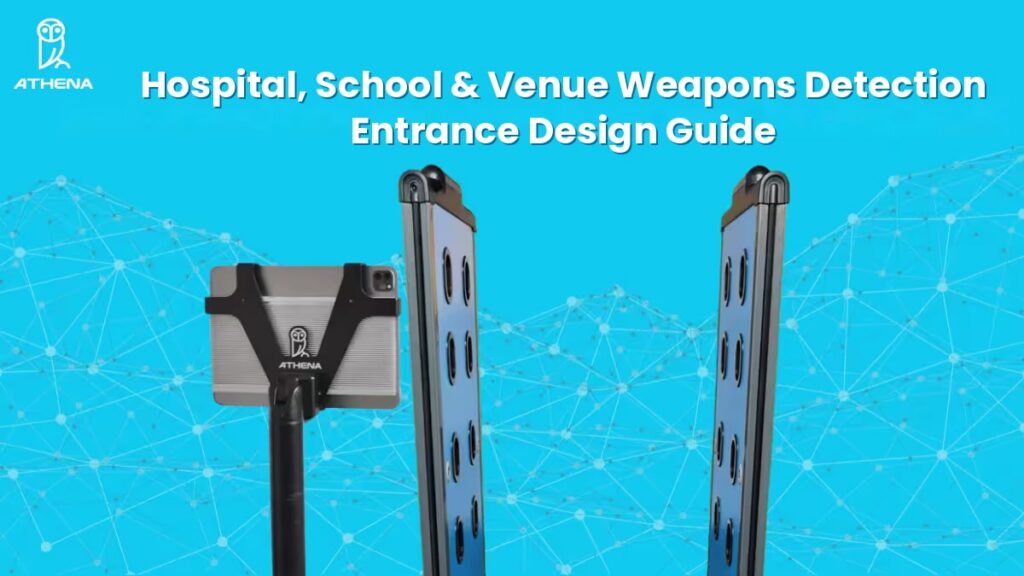

| Summary: Most weapons-detection buying guides start with throughput numbers. This one starts with the threat. The Hospital, School & Venue Weapons Detection Entrance Design Guide walks through the design method behind a working entrance: define the smallest weapon you need to find, set the sensitivity to detect it, measure the real alarm rate at that setting, and only then choose hardware and staffing.
The guide covers:
Every external claim is verified against NIJ, ASTM, NIST, DHS SAVER, CDC, or peer-reviewed sources, listed in full at the end. Operational figures used as planning examples are labeled as such. |
How should a hospital, school, or venue design a weapons-detection entrance?
Start with the smallest threat the entrance must detect, not with the maximum advertised throughput number. That target determines the required sensitivity, and the sensitivity determines the alarm rate, divestment, secondary screening, staffing, queue length, and effective secure throughput. This is the same logic the federal test standards use: NIJ 0601.02 and ASTM F3566-22 both define detection performance against classes of test objects (large, medium, small) rather than against a single “weapon” category, because a detector tuned for one class is not automatically tuned for the others. [1][2]
For this guide, a “small knife” means a metallic knife with a blade of approximately 5 inches or less. This is a practical procurement benchmark, not a universal industry definition. NIST’s own test-object research notes that the metal threats a walk-through detector is expected to find range from handguns to disposable razor blades, in ferromagnetic and non-ferromagnetic metals. [3] A five-inch blade can still be life-threatening, and the parent, teacher, nurse, or visitor being protected cares whether it can be detected — not what category label an industry document gives it.
The sensitivity tradeoff
Smaller threat target → higher sensitivity → more everyday objects detected → more alarms → more divestment → more secondary screening → more staffing → lower effective throughput. A firearm-focused setting and a five-inch-knife setting are not equivalent tests.
This is not theoretical. The U.S. Federal Trade Commission’s 2024 complaint against one weapons-detection vendor described a school that raised its system’s sensitivity after a seven-inch knife was reportedly missed and then experienced a 50% false-alarm rate; the vendor itself acknowledged that its more sensitive setting would produce more false alarms and could require additional staff. [4] Hospitals and schools should therefore require every vendor to show the smallest threat target, the exact security setting required to detect it, and the nuisance / secondary-screening rate at that same setting. Throughput demonstrated at a different setting should not be treated as comparable.
Why X-ray becomes important
When a high-sensitivity WDS starts alerting on laptops, metal bottles, chargers, medical items, and cluttered bags, repeatedly opening every bag can destroy throughput. Separating the screening problems is often more scalable: Person → WDS; Bag / divested items → X-ray. X-ray can also address ceramic objects, vapes, alcohol containers, and other prohibited items that a metal-focused WDS cannot classify well. ASTM F792 is the reference standard for evaluating security X-ray imaging performance, and buyers can ask any X-ray vendor how the proposed unit performs against it. [2]
The math: 1,500 students
DHS’s SAVER program notes that while a screening portal itself needs only one operator, a screening lane can require three or more people — one to guide entrants, one to operate, and one to resolve alarms. [5] The table below shows why the alarm rate, not the sensor speed, drives that headcount. The 40% and 80% secondary-screening rates are planning examples, not measurements; the FTC-documented 50% figure above sits inside that range.
|
Scenario |
Secondary screenings |
20 sec each |
Officer-minutes |
Equivalent labor |
|
1,500 students @ 40% secondary rate |
600 |
12,000 sec |
200 |
3 hr 20 min |
|
1,500 students @ 80% secondary rate |
1,200 |
24,000 sec |
400 |
6 hr 40 min |
This is why the number that matters is effective secure throughput: people completely cleared through the whole checkpoint divided by total time. A detector can process a sensor transaction in a second and still produce a slow entrance if hundreds of people then require manual resolution.
Hospital entrance guide
|
Hospital entrance |
Recommended architecture |
Design reason |
|
Main lobby |
WDS + X-ray + visitor management |
High volume, bags, identity, firearm + knife threat matrix |
|
Employee entrance |
WDS + access control + defined divestment |
Known people, repeat belongings, predictable workflow |
|
Emergency department |
Higher-sensitivity WDS + X-ray + controlled access |
Higher-risk traffic; knives and firearms both matter |
|
Ambulance bay |
Dedicated stretcher-compatible detection |
Conventional WDS can be overwhelmed by the metal stretcher itself |
|
Behavioral health / high security |
Higher-sensitivity WDS + X-ray + controlled access |
Smaller edged threats may matter more than frictionless throughput |
|
Narrow footprint |
Compact WDS / portable / passive options as appropriate |
Architecture may eliminate some portal designs |
|
High-volume urban entrance |
WDS + X-ray + VMS + access logic |
Need both security and complete checkpoint throughput |
Hospitals need knife detection
The healthcare evidence on this point is unusually clear. A 2024 systematic review and meta-analysis of 14 U.S. studies published between 1984 and 2023 found an overall pooled weapons prevalence of 4.0% among patients and visitors screened, and most of those weapons were bladed: 3.8% bladed, 0.6% other weapons, and 0.1% firearms. Prevalence was 1.6% among people entering an emergency department and rose to 24.3% when major-trauma patients were hand-searched. [6] A 26-month study of a single urban teaching-hospital ED that installed a metal detector in 2011 retrieved 5,877 weapons — an average of 218 per month — of which 4,842 were knives, 268 were firearms, 512 were chemical sprays, and 275 were other items such as brass knuckles, stun guns, and box cutters. [7] A 2023 before-and-after study at another urban Level 1 trauma-center ED found that moving from screening only behavioral-health patients to screening everyone increased persons screened roughly 25-fold and weapons confiscated roughly 6- to 13-fold. [8]
A hospital that tests only a handgun therefore validates against the rarest weapon in its own threat profile. The screening setting must be chosen against the knife.
Medical devices and the screening population
Hospitals screen a population that is more likely than average to have implanted or worn medical devices. ASTM F2401-24 is the standard guide for security-checkpoint screening of persons with medical devices using metal detectors, and it belongs in the hospital’s screening procedure alongside the vendor’s own guidance. [2] Passive-sensing products are often marketed on this point; the procedural answer is to have a documented alternative-screening path regardless of the technology chosen.
Ambulance-bay exception
Ambulance arrivals are a special problem because the patient may be lying on a large metal stretcher surrounded by medical equipment. The requirement is not merely to alarm on the stretcher; it is to detect a weapon despite the stretcher. The 2023 ED study above handled this with bedside screening and a baggage check by security officers for ambulance arrivals — a workable procedure, but a manual one. [8] This should be treated as a separate entrance category. Athena offers a purpose-built ambulance-bay detector for this use case. [9]
School entrance guide
|
School entrance |
Recommended architecture |
Primary problem |
|
Bus drop-off |
High-throughput WDS + X-ray where bags are screened |
Large burst of backpacks / laptops |
|
Main student entrance |
WDS + X-ray |
Weapons + knives + prohibited items |
|
Car drop-off |
Multi-lane WDS + X-ray + bypass control |
Burst traffic and multiple approach paths |
|
Visitor entrance |
WDS + visitor management + bag screening |
Identity + weapons + restrictions |
|
Employee entrance |
WDS + access control |
Known-person fast screening |
|
Athletic / event entrance |
Portable high-throughput WDS |
Temporary high-volume crowd |
|
High-threat entrance |
Higher-sensitivity WDS + X-ray |
Broader knife / firearm threat matrix |
Installation matters as much as selection at school entrances: ASTM C1238-24 is the standard guide for installing walk-through metal detectors, and NIJ 0601.02 includes tests for operation near metal walls, steel-reinforced floors, and moving metal doors — all common at school entries. [1][2]
Vapes change the school requirement
Schools often want to address more than firearms. In the 2025 National Youth Tobacco Survey, e-cigarettes or vapes remained the most commonly used tobacco product among U.S. middle and high school students: 5.2% reported current use, and among those students 41.2% used frequently (20 or more days a month) and 66.3% used disposable vapes — the small, metal-cased devices most likely to be carried in a backpack. [10][11] Locally, Marin County’s public health officer stated in an October 2025 county release that nearly half of Marin 11th graders report having tried vaping, and the county has proposed an ordinance that would ban retail sale of electronic smoking devices. [12] If a district wants to find firearms, smaller knives, and vapes in backpacks, a WDS-only proposal and a WDS + X-ray proposal are not equivalent security architectures.
A note on expectations: a 2025 University of Michigan scoping review found only two empirical studies in twenty years that met its criteria for evaluating weapon-carriage interventions in K-12 schools, and it cautions that target-hardening can affect students’ sense of safety. [13] Districts should pair any screening program with measurement of what it actually finds and how students experience it.
Event and venue entrance guide
Large venues have the hardest burst-throughput problem. A concert, arena, or festival may need to clear thousands of people in a narrow arrival window. Real crowds do not behave like trained demo subjects: people stop, bunch together, turn, carry drinks and bags, ask questions, ignore instructions, and some may be intoxicated. Crowd-flow engineering is therefore part of the weapons detection system. DHS’s 2024 market survey of walk-through screening systems was written specifically for these “soft target” venues and is the best independent starting list of products; it also states that the performance data it reports came from manufacturers and was not independently verified. [14]
High-volume progressive screening architecture
Primary high-throughput WDS → CLEAR left / straight → enter venue; ALERT right → shared secondary line → bag / divested items through X-ray when required + person through higher-sensitivity WDS → if still alerting, hand wand / focused search.
This design keeps the main lanes moving. Do not resolve a complex alert in the primary WDS lane. Divert the person and immediately feed the next guest into the detector.
Multiple lanes can share alert-resolution capacity
A venue can funnel multiple primary lanes into fewer secondary areas — for example, two primary WDS lanes into one shared alert line — as long as measured alarm demand does not exceed the secondary lane capacity. The correct ratio is an engineering calculation, not a fixed rule.
Firearm-only vs. five-inch-knife architecture
|
Threat requirement |
Primary screening |
Alert-line screening |
X-ray |
Final resolution |
|
Larger firearms |
High-throughput WDS |
Focused secondary WDS / hand wand |
Optional depending on bag policy |
Hand wand if needed |
|
Firearms + larger knives |
High-throughput WDS |
Higher-sensitivity WDS |
Recommended for bag-heavy events |
Hand wand |
|
Firearms + ≤5-inch metallic knives |
High-throughput WDS |
High-sensitivity WDS |
Strongly recommended |
Hand wand / targeted search |
|
Firearms + knives + nonmetallic bag threats |
High-throughput WDS |
High-sensitivity WDS |
Required as part of a complete bag strategy |
Focused search |
Marketing throughput vs. real-world throughput
Vendor throughput figures are typically produced under favorable conditions. To get close to 2,000+ people per hour per lane on a high-throughput system, the venue has to engineer the flow: funnel the crowd, provide instructions before the detector, actively control spacing, keep the primary lane moving, divert alerts immediately, and ensure the secondary queue never backs up into the primary lane.
A detector capable of 2,000+ people per hour can still become a slow checkpoint if people stop in the lane. The slowest stage controls the entire pipeline.
Example pipeline
Crowd arrival → queue / funnel → primary WDS → clear / alert split → secondary WDS + X-ray where needed → hand wand / final resolution → venue entry.
At a venue, the funnel should be treated as part of the WDS deployment. Barricades, floor markings, clear signs, and a traffic-directing officer should make the correct behavior obvious before a guest reaches the sensor.
Required acceptance-test record
NIST’s metal-detector metrology group has shown that small changes in the orientation of a test object relative to the detector’s field can make a detector appear to perform better than it actually does, which is why both NIJ and ASTM specify test-object geometry and positioning. [3][15] Record every variable below so the result can be reproduced.
|
Record every test variable |
Why |
|
Vendor, model, hardware / software version |
Prevents apples-to-oranges comparisons |
|
Security preset / sensitivity |
Connects detection and throughput to the actual operating state |
|
Threat object + blade length + material (ferrous / non-ferrous) |
Defines what “knife detection” actually means; NIJ and ASTM test objects include both metal classes |
|
Threat orientation + body location |
Orientation can materially change response (NIST) |
|
Normal bag / belonging mix |
Shows real clutter conditions |
|
Divestment required |
Reveals operational friction |
|
Normal-traffic alarm rate |
Determines secondary-screening load |
|
Bag alarm rate |
Determines need for X-ray / manual search |
|
Average resolution time |
Allows staffing math |
|
Actual cleared throughput |
Measures the whole checkpoint, not the sensor alone |
The key procurement question
Ask every vendor: “At the exact security setting required to reliably detect our five-inch-and-smaller metallic knife threat target, what are the real-world alarm rate, divestment requirements, secondary-screening workload, staffing requirements, and effective secure throughput?”
Then test it with the same threat kit, same belongings, and same entrance conditions. The hardware should follow the security requirement — the security requirement should not be weakened simply to make a particular detector appear frictionless.
Bottom line
Hospitals, schools, and venues need different entrance architectures, but the design method is the same: define the threat, determine the necessary security setting, measure the real alarm rate, design divestment, decide where X-ray belongs, calculate secondary-screening labor, and only then select the hardware. For busy entrances seeking both small-knife security and high throughput, the practical answer is often a layered architecture rather than one detector turned to maximum sensitivity.
For vendor-by-vendor sensing technology, limitations, and post-alert workflow, see the companion guide: Top Concealed Weapons Detection Vendors in 2026.
Chris — CTO & Co-Founder, Athena Security
Sources and verification links
Peer-reviewed, government, and standards-body sources are listed first. All links were checked on September 10, 2026.
[1] National Institute of Justice — NIJ Standard-0601.02, Walk-Through Metal Detectors for Use in Concealed Weapon and Contraband Detection
https://nij.ojp.gov/library/publications/walk-through-metal-detectors-use-concealed-weapon-and-contraband-detection-0
[2] ASTM International — Security system standards: F3566-22 (walk-through metal detectors), C1238-24 (installation), F2401-24 (screening persons with medical devices), F792 (security X-ray imaging performance)
https://store.astm.org/products-services/standards-and-publications/standards/security-system-standards-pedestrian-and-walkway-safety-standards.html
[3] NIST — Paulter, Ely & Barry, Test Objects for the Accurate and Reproducible Evaluation of the Threat Detection Performance of Walk-Through Metal Detectors (ASTM J. Testing & Evaluation, 2021)
https://www.nist.gov/publications/test-objects-accurate-and-reproducible-evaluation-threat-detection-performance-walk
[4] U.S. Federal Trade Commission — press release, FTC Takes Action Against Evolv Technologies (Nov. 26, 2024)
https://www.ftc.gov/news-events/news/press-releases/2024/11/ftc-takes-action-against-evolv-technologies-deceiving-users-about-its-ai-powered-security-screening
[5] DHS S&T SAVER — TechNote SAVER-T-TN-46, Walk-Through Screening Systems for Mass Casualty Threats (May 2024)
https://www.dhs.gov/sites/default/files/2024-05/24_0522_st_weaponsscreeningtechnote.pdf
[6] McGuire et al. — Prevalence of Weapons in the Health Care Setting: A Systematic Review and Meta-Analysis (2024), PMC11713507
https://pmc.ncbi.nlm.nih.gov/articles/PMC11713507/
[7] Malka, Chisholm, Doehring & Chisholm — Weapons Retrieved After the Implementation of Emergency Department Metal Detection, J Emerg Med 2015;49(3):355-8, PMID 26153030
https://pubmed.ncbi.nlm.nih.gov/26153030/
[8] Impact of Implementation of a New Weapons Screening at an Urban Emergency Department, J Emerg Med (2023)
https://www.jem-journal.com/article/S0736-4679(23)00433-X/abstract
[9] Athena Security — Healthcare weapons detection platform (ambulance-bay detector)
[10] Tobacco product use among middle and high school students in the United States: National Youth Tobacco Survey, 2025 — Nicotine & Tobacco Research (June 2026)
https://academic.oup.com/ntr/advance-article/doi/10.1093/ntr/ntag116/8712569
[11] U.S. FDA / CDC — Results from the Annual National Youth Tobacco Survey (2025 data)
https://www.fda.gov/tobacco-products/youth-and-tobacco/results-annual-national-youth-tobacco-survey-nyts
[12] County of Marin — Board of Supervisors to Consider Tobacco Pricing and Sales Ordinance (Oct. 17, 2025 news release quoting the County Public Health Officer)
https://www.marincounty.gov/news-releases/board-supervisors-consider-tobacco-pricing-and-sales-ordinance
[13] Stilwell et al. (2025) — Securing schools, protecting minds: a scoping review of limited evidence for weapon carriage prevention in K-12 schools
https://www.ncbi.nlm.nih.gov/pmc/articles/PMC12713219/
[14] DHS S&T SAVER — Walk-Through Weapons Screening Systems for Mass Casualty Threats, Market Survey Report (Sept. 2024)
https://www.dhs.gov/sites/default/files/2024-09/24_0924_st_weaponsscreeningmsr_1.pdf
[15] NIST — Paulter, Larson & Ely, Test Object for Accurate and Reproducible Measurement of the Detection Response of Hand-worn and Hand-held Metal Detectors, J. Res. NIST 121 (2016)
https://nvlpubs.nist.gov/nistpubs/jres/121/jres.121.019.pdf
[16] CDC — E-Cigarette Use Among Youth (background page)
https://www.cdc.gov/tobacco/e-cigarettes/youth.html
[17] NCES — Digest of Education Statistics, Table 233.50: Percentage of public schools with various safety and security measures (benchmark for metal-detector use)
https://nces.ed.gov/programs/digest/d23/tables/dt23_233.50.asp
Operational figures in this guide (for example, the 40% or 80% secondary-screening scenarios) are planning examples unless a deployment-specific measurement or published study is explicitly identified. Actual alarm rates vary by detector, threat target, sensitivity, belongings, environment, and population. Validate all assumptions during acceptance testing. This guide is published by Athena Security and references Athena products; verify competitor and standards information directly with the issuing body.
Disclaimer:
The information provided in this article is based solely on publicly available sources and is intended for general informational and guidance purposes only. It should not be relied upon as a final decision-making resource or as a substitute for professional advice. While we strive for accuracy and completeness, we make no representations or warranties regarding the correctness, reliability, or suitability of the content. If you believe any information should be updated, corrected, or removed, please contact our team for review.