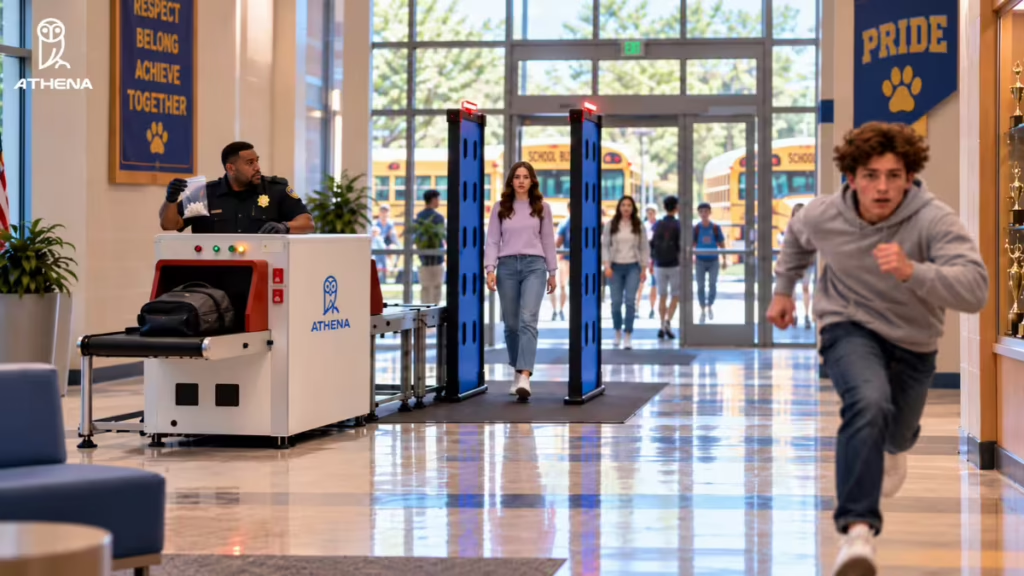

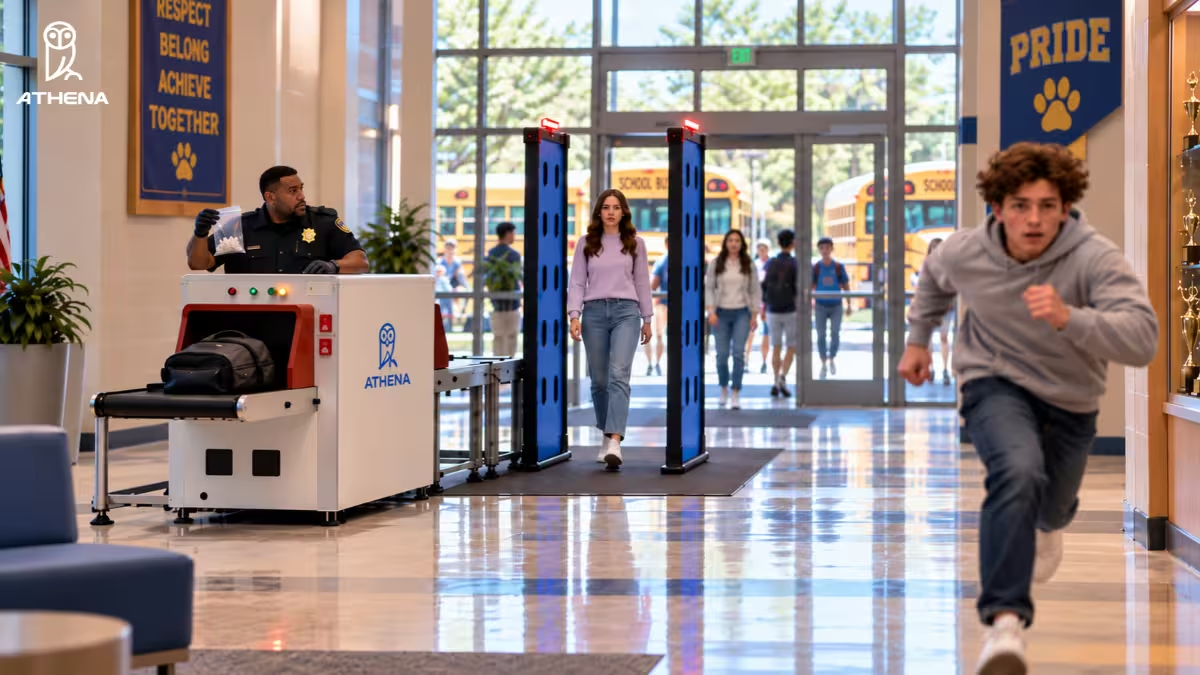
| Summary: Bag-to-person identification during baggage screening matters for schools because it directly links each screened bag/personal belonging to the student/visitor who brought it inside. In case a concealed weapon/knife, drugs, or vapes is detected in a bag, and the bag owner flees, this feature helps security teams quickly identify the person. |
A few months back, our AI X-Ray Baggage Scanner flagged heroin inside a student’s backpack. But by the time security noticed the alert, 10 seconds had passed, and the student had already collected their bag and entered campus. There was no way to identify them quickly.
This single incident made us think: Security teams can miss alerts when 2,000 students pass through an entrance per hour. Additionally, a baggage scanner might not flag an item it wasn’t configured to detect. So, when security reviews an X-ray scan later and spots a prohibited item, how do they identify the student who brought it into the security checkpoint?
The same challenge arises when you find an abandoned bag or when a student denies bringing a flagged bag inside campus. That’s why we introduced bag-to-person identification in our X-ray baggage scanners. It links each X-ray scan to a photo of the bag’s exterior and the student or visitor who entered with it.
This article explains what bag-to-person identification during baggage screening is and why it matters for schools.
| Note: The phrase “bag owner” denotes the student, staff member, or visitor who brought the bag into your school and placed it on the conveyor belt during baggage screening. For example, if Student A steals Student B’s bag, hides a weapon inside, and enters the school with it, then Student A is the bag owner. |
What Is Bag-to-Person Identification During Baggage Screening
Bag-to-person identification during baggage screening is a feature in Athena Security’s AI X-Ray baggage scanner that provides a visual record of every screened bag and the person placing it on the conveyor belt.
What Happens During Bag-to-Person Identification
Here’s what happens during bag-to-person identification when schools use our AI X-Ray Baggage Scanner:
- Camera Trigger: The moment someone places their backpack or parcel on the conveyor belt, built-in sensors trigger NDAA-compliant cameras positioned at the entry point.
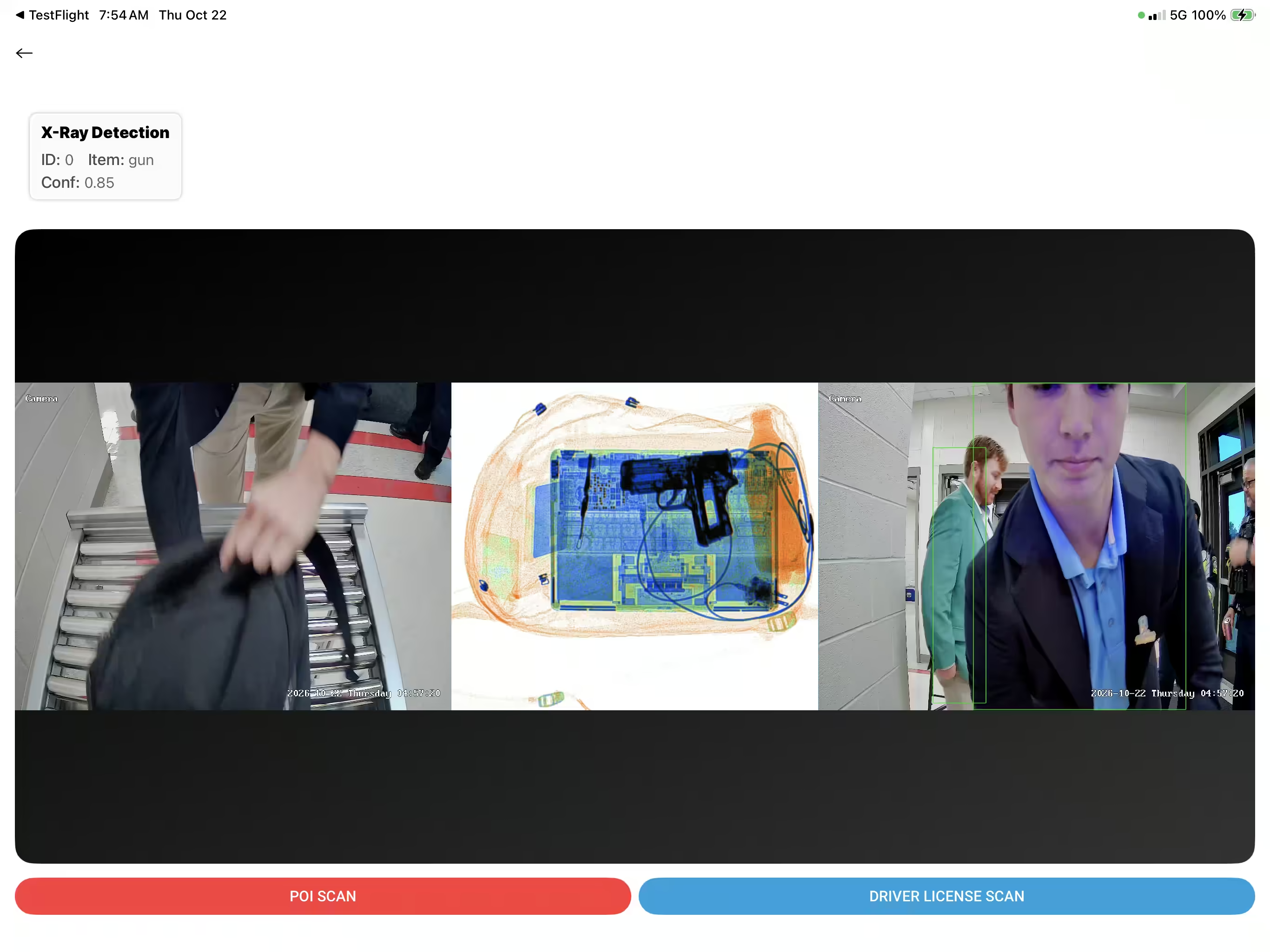
- Triple-Image Capture: The integrated cameras quickly capture three images: the bag’s X-ray scan, an external photo of the bag’s physical appearance, and the bag owner’s face and clothing.
- Unified Console Feed: The Athena Operator App syncs the three images together into a single record (as in the image below). Security teams can access/review it anytime on the iPad console provided with the baggage scanner.
Why Does Bag-to-Person Identification During Baggage Screening Matter Especially for Schools
Bag-to-person identification is a critical requirement for schools because of the unique operational challenges only they face:
| Challenge | Explanation | Example |
| Tracing Owners of Flagged Bags After They Flee | A student may grab a flagged bag and run before screening is complete. Officers must then chase the student or identify them from memory. | In March 2026, staff at Hephzibah High School found a gun inside a student’s bookbag during weapons screening. The student ran away with the bag, and staff later caught him in the parking lot. |
| Unclaimed Bags Are Hard to Trace | There’s often no quick way to trace who brought an unattended bag or safely check what’s inside. Reconstructing the incident using CCTV helps only if cameras covered the spot. | When a suspicious bag was discovered at Dover Area Middle School in March 2026, they notified law enforcement. Later, investigators found the backpack contained a pair of shoes and posed no threat. |
| Investigations Disrupt the School Day | Investigations can halt entry lines, relocate students, or trigger campus-wide lockdowns. | In the Dover incident, students were relocated to the high school while law enforcement and administrators inspected the middle school building. |
| Security Officers Question the Wrong Student | When officers rely on memory or a rough description, they may pull aside an innocent student. This causes unnecessary stress and damages trust between the school and the students. | Scenario: A guard remembers a flagged bag’s owner as “a tall student in a gray hoodie” and pulls a matching student out of class. That student turns out to be innocent. |
| Many Students Carry Similar-Looking Bags | Students might carry identical or nearly identical backpacks. If security officers review an X-ray alert after a bag exits the scanner, they can easily get confused in a crowded hallway and misidentify the owner. | Scenario: The scanner flags a plain white backpack during morning entry. By the time the officer looks up, the bag is back with its owner, among dozens of students carrying similar backpacks. |
| Students Deny Owning Flagged Bags | When security confronts a student with a flagged bag, the student can easily claim it isn’t theirs. | Scenario: Guards stop a student carrying a flagged bag. The student says the bag belongs to someone else. Without ID inside, staff can’t confirm whether they’re telling the truth. |
| High-Volume Morning Arrivals Can Increase Missed Alerts | Unlike hospitals or offices, where visitors arrive throughout the day, schools need to screen a large number of students quickly for weapons. During this rush, alerts are more likely to be missed. By the time security notices one, it may be too late to trace the bag owner. | Scenario: An officer misses a knife alert in a bag during the morning rush. The security lead spots it while reviewing the stored scans that afternoon. By then, hundreds of students have passed through the checkpoint. |
What Are the Benefits of Bag-to-Person Identification During Baggage Screening for Schools
Below are the four benefits of using bag-to-person identification during baggage screening for schools:
- Helps Quickly Identify the Bag Owner: Visual evidence helps security teams trace the owner long after they’ve exited the security checkpoint and hold them accountable. Even if multiple students have similar-looking bags, security officers can use this record to identify the student carrying the exact bag. Plus, it resolves bag-ownership disputes.
- Creates a More Comfortable Screening Experience for Students: When security officers base their follow-up questioning on visual evidence, innocent students are far less likely to be singled out or unfairly suspected. Students can walk through the screening checkpoint with confidence, knowing their privacy and dignity are protected.
- Simplifies the Process of Handling Abandoned Bags: Security can pull up the stored X-ray scan on their console and assess the items inside. This lets them inspect the bag’s contents virtually and safely.
- Reduces Response Time and Minimizes Campus Disruptions: Because security personnel can identify owners of screened bags in seconds, they never have to freeze morning entry lines or trigger campus-wide lockdowns (unless there’s a verified threat). If an alert requires follow-up, officers can later discreetly locate the suspected student on campus without alarming the entire school.
| Expert Advice: It’s best to combine a walk-through Concealed Weapons Detection System (WDS) with an AI-assisted X-ray scanner to screen students and their personal belongings for threats. This setup forms the primary layer of your school’s entryway security. Bag-to-person identification sits on top of this layer, helping you immediately locate bag owners and close the response gap. |
How Does Athena Security Help Schools With Weapon Screening
We help schools build a fast, effective, and compliant weapon-screening process that goes beyond our specialized hardware. We start with on-site facility assessments to evaluate arrival routes, bus drop-offs, and entryway architecture per DHS guidelines. We then help you build a weapons screening rollout plan before go-live. Post-deployment, we offer hands-on, role-based training for your security officers, administrators, teachers, and other staff.
We’re also FERPA-compliant, ensuring complete student data privacy through configurable data retention options, device-side encryption, two-factor authentication, and more.
Leading K-12 schools and school districts, including Del Valle High School, Lamar Consolidated Independent School District, and Hosanna Christian Academy, have partnered with us to safeguard their campuses.
Del Valle Independent School District has also ranked us first in their evaluation of student safety screening systems.
Here’s an excerpt from their Board of Trust Meeting notes:
“Athena was selected from a list of qualified companies following a comprehensive review and ranking process. Based on criteria such as system performance, ease of deployment, maintenance, and cost-effectiveness, this vendor ranked at the top of the list. This initial purchase will allow the District to test and assess real-time application in a school setting before making recommendations for expanded deployment in the future.”
To see our bag-to-person identification in action or test it in your school, book a demo below or call us at 1-833-928-4362 to get started.
Frequently Asked Questions About Bag-to-Person Identification Feature In Athena Security’s Baggage Scanner
As you decide your next step, you may still have questions about bag-to-person identification. Below, we answer commonly asked questions about using bag-to-person records, evaluating X-ray baggage scanners, and procuring from Athena Security.
1. Who Should Be Allowed to Access Bag-to-Person Identification Screening Records?
Only authorized security personnel, school administrators, and designated School Resource Officers (SROs) on duty should have access to live feeds and historical bag-to-person screening records. Grant this access strictly through role-based permissions to protect student privacy and maintain compliance.
Schools should share screening logs externally only with law enforcement or emergency services during verified threat escalations or formal investigations.
2. How Can Schools Evaluate if Bag-to-Person Identification Is Actually Improving Their Screening Workflows?
Schools can evaluate the impact of bag-to-person identification by tracking four performance metrics:
- Time to Identify the Bag Owner: Measure how fast your security team can identify the bag owner.
- Time to Locate the Flagged Bag: Check how quickly guards can locate the flagged bag using its internal X-ray scan.
- False Association Rate: Track if there’s a reduction in the number of misidentified bag owners.
- Automated Audit Readiness: Calculate the total time saved by automatically logging timestamped image files for compliance reviews.
However, these four metrics only measure the effectiveness of bag-to-person identification. Your screening workflow may still have gaps that can lead to missed small-edged weapons.
To fix that, read our guide on how to prevent knives and small weapons from entering schools.
3. Can Schools Use Athena Security’s Bag-to-Person Records During Disciplinary Investigation?
Yes, schools can use bag-to-person identification records during disciplinary investigations because they retain 100% data ownership. School administrators can access and export complete digital audit trails (timestamps, X-ray scans, bag photos, and person captures) as evidence of policy violations or prohibited-item confiscations.
4. How Can Schools Evaluate X-Ray Baggage Scanners?
Here’s how schools can evaluate X-ray baggage scanners for entryway screening:
- Check for Dual-Energy Imaging: The scanner should analyze an object’s material density and atomic number (not just its shape) to flag small-edged weapons and non-metallic threats.
- Ask If You Can Adjust the Conveyor Belt Speed: Adjustable speeds let you process up to 2,000 bags per hour during morning arrival and reduce it when traffic is lighter.
- Confirm That the Scanner Links Bags to Owners: It should automatically capture the bag’s exterior, the internal X-ray scan, and the owner’s face. Also, test the accuracy of these links during crowded entries.
- Choose a Portable Console: An operator console that’s not bolted down on the scanner lets staff review alerts as they move around campus.
- Test how the Scanner Handles Threats: The X-ray scanner should stop the conveyor belt the moment a threat is flagged and contain the bag inside.
- Verify Radiation Safety: The scanner should meet FDA radiation leakage limits for cabinet X-ray systems.
Read More: School Weapons Detection System and X-Ray Baggage Screening Buying Guide 2026
5. How Can I Choose the Best School Security System for My Campus?
To choose the best school security system that fits your campus’ security needs, you must:
- Start with a vendor that serves K-12 schools.
- Identify what threat types the system can actually detect (and if they match your target threat profile).
- Check if the system complies with FERPA standards.
- Assess how well the system integrates with your existing screening equipment and workflows.
- Evaluate vendor support, training, and testimonials.
To learn more, read our guide to the 7 best school security systems in 2027. It includes our top recommendations for school security systems, plus a quick checklist to help you choose the right option for your campus.
6. How Can I Procure School Security Solutions from Athena Security?
To procure our school security solutions, you can book a free live demo below. Our experts will respond within 24 hours to discuss your school’s custom requirements and walk you through our security solutions. After that, we’ll conduct an on-site or virtual assessment to evaluate your entrance layouts and foot traffic patterns before providing a customized quote.
You can also email us at [email protected] or call us at +1-833-928-4362.
Disclaimer: The images have been created using AI-based tools and are intended for illustrative purposes only. They may not accurately represent real individuals, locations, or situations. Any resemblance to real persons, living or dead, or actual events is purely coincidental.