
| Summary: Traditional metal detectors only detect metal. They don’t help security officers identify weapons from everyday items or catch non-metallic ones. To replace them, schools can go for three reliable alternatives: Concealed Weapons Detection (CWD) Systems, Video and Camera Analytics, and Proactive and Administrative Systems. These systems can be layered together to support different aspects of school safety: entryway screening, campus monitoring, and early threat prevention. Learn how to choose the right alternative for your K-12 school/district. |
In February 2026, a student got a weapon inside Venice High School (Florida) despite metal detectors on campus. A parent of another student later highlighted that everyday items like glasses cases often set off the school’s detector. When this happened, the staff simply waved students through. Some of these students carried musical instruments, which weren’t even scanned or checked for concealed weapons
This story is the reality of many K-12 schools using traditional metal detectors. These systems only detect metal. They don’t tell you whether that metal is a laptop or a concealed weapon. They don’t even show exactly where the metal is on a student’s body or in their backpack.
When an alert goes off, security officers must manually check the student and their bags for the object. During this manual check, many officers miss a concealed weapon. This is exactly what happened at the Sam Houston High School in Louisiana earlier this year.
These are some of the common (and most critical) challenges with metal detectors that new-age alternative solutions like AI-powered weapon detection systems can solve. These systems can analyze an object’s composition to distinguish a weapon from an everyday item, while also pinpointing the exact location of the item.
To help you identify one such alternative to a metal detector for your school, we have broken down the top three alternatives in this article. We’ve also provided a checklist that will help you pick the right alternative for your campus.
But first, let’s understand
Why Are Traditional Metal Detectors Not Enough in Schools
Traditional metal detectors can fail to catch weapons in schools or slow down screening.
Here’s why:
- Frequent False Alarms: Metal detectors measure the total mass of metal passing through. They don’t analyze what each object inside a backpack or on a student is made up of. So a steel bottle or a foil binder can set off the same alarm as a weapon. Students get pulled aside for everyday items, which slows the line.
- Vulnerability to Non-Metal Threats: Metal detectors only react to metal. So ceramic knives or 3D-printed weapons don’t register. A student can carry one in a pocket or backpack and pass screening without setting off a single alert.
- They Don’t Show Where a Threat Is Hidden: A metal detector alarm tells officers there’s metal somewhere on the student or in their backpack. It doesn’t pinpoint whether that object is in their jacket, bag pocket, or near the shoes. Officers must wand or pat down students to resolve the alert, which delays morning entry.
- Increased Cognitive Load on Your Security Guards: A metal detector can’t tell officers what set off an alarm, so they have to figure it out themselves. During the morning rush, a steady stream of false alarms leads to alert fatigue. Officers may then assume a phone or binder triggered the next alert and wave the student through. If the alert was actually a weapon, it’s now inside the school.
- Might Not Be Safe for Students With Pacemakers and ICDs: Legacy metal detectors and handheld wands transmit electromagnetic fields that may interfere with pacemakers and implanted defibrillators (ICDs). Such students/staff often need slower, hands-on screening to avoid prolonged exposure.
Read More: Why Are Walkthrough Metal Detectors Missing Weapons In Schools
What Are the Alternatives to Metal Detectors in Schools
Schools can use different security systems to detect weapons and keep them off campus. When layered wisely, these systems can replace traditional metal detectors and make your campus safer. They include:
- Concealed Weapons Detection (CWD) Systems for Weapon Screening
- Video and Camera Analytics for Surveillance
- Proactive and Administrative Systems for Early Threat Prevention
Let’s discuss each in detail.
1. Concealed Weapons Detection (CWD) Systems for Weapon Screening
Concealed Weapons Detection (CWD) systems directly replace traditional metal detectors for schools. They combine advanced sensor technology with AI software to detect hidden weapons (firearms, knives, razor blades) inside a student’s clothing or bags/personal belongings.
This allows CWD systems to:
- Detect Weapons While Ignoring Everyday Items: AI object recognition helps flag mass-casualty firearms, knives, razor blades, etc., without triggering alerts on phones, keys, coins, laptops, water bottles, etc.
- Catch Non-Metallic Weapons: They analyze an object’s material, shape, density, etc., to identify non-metallic weapons like ceramic knives, 3D-printed weapons, and explosives.
- Pinpoint Location of Concealed Weapons: When a potential threat is spotted, the system immediately flags the location on the person’s body/clothing/bag, showing security teams exactly where to look.
- Keep Morning Lines Moving: They can screen hundreds of students or bags per hour.
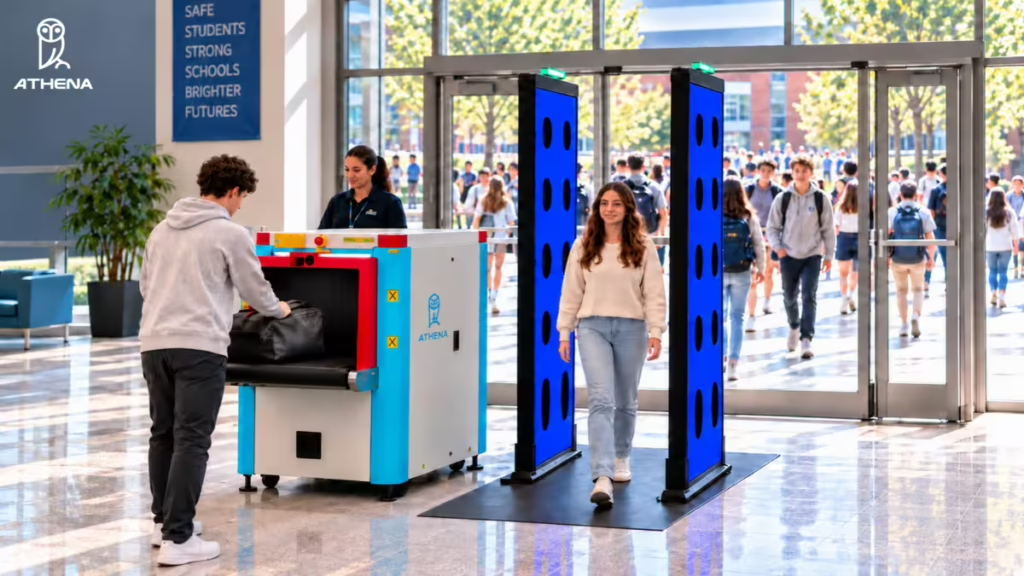
For instance, schools can deploy our Apollo 500 Concealed Weapons Detection system to screen students non-invasively, while our AI X-Ray Baggage Scanner checks their backpacks for hidden weapons at the same time.
Here’s a short video that demonstrates this in action:
Here’s a quick table explaining how our complete entryway screening setup would work at your school campus:
| Stage | What Happens At Your School’s Weapon Screening Checkpoint |
| Entry | A student places their backpack on the AI X-ray baggage scanner, then walks through the CWD portal. |
| Baggage Screening | Dual-energy imaging reads the atomic composition of every item inside, from textbooks to a water bottle. AI checks it for 80+ threat types, including mass-casualty firearms and small edged weapons like 2- to 2.5-inch blades. If it spots a threat, the belt stops automatically and holds the bag inside the tunnel. |
| Student Screening | The student walks through the CWD portal at a normal pace, without stopping or emptying their pockets. Active-wave sensors scan the student’s body for weapons while filtering out everyday items. The operator’s iPad shows the exact location of any threat on a 3D body avatar. |
| Secondary Screening | If the CWD portal flags the student, an officer guides them to our Secondary Screening WDS™ stationed near the main lane. Its non-ionizing imaging radar reflects off skin and surface layers to detect concealed objects. The officer resolves the alert without a pat-down or wanding. |
While our AI gives officers accurate weapon alerts, they may miss or accidentally clear these alerts during high-volume morning rushes. To solve this, our Second Look feature automatically re-checks cleared X-ray images in the cloud. An expert reviewer analyzes these scans. If a weapon is found, the officer’s iPad receives the alert again within 5-7 seconds.
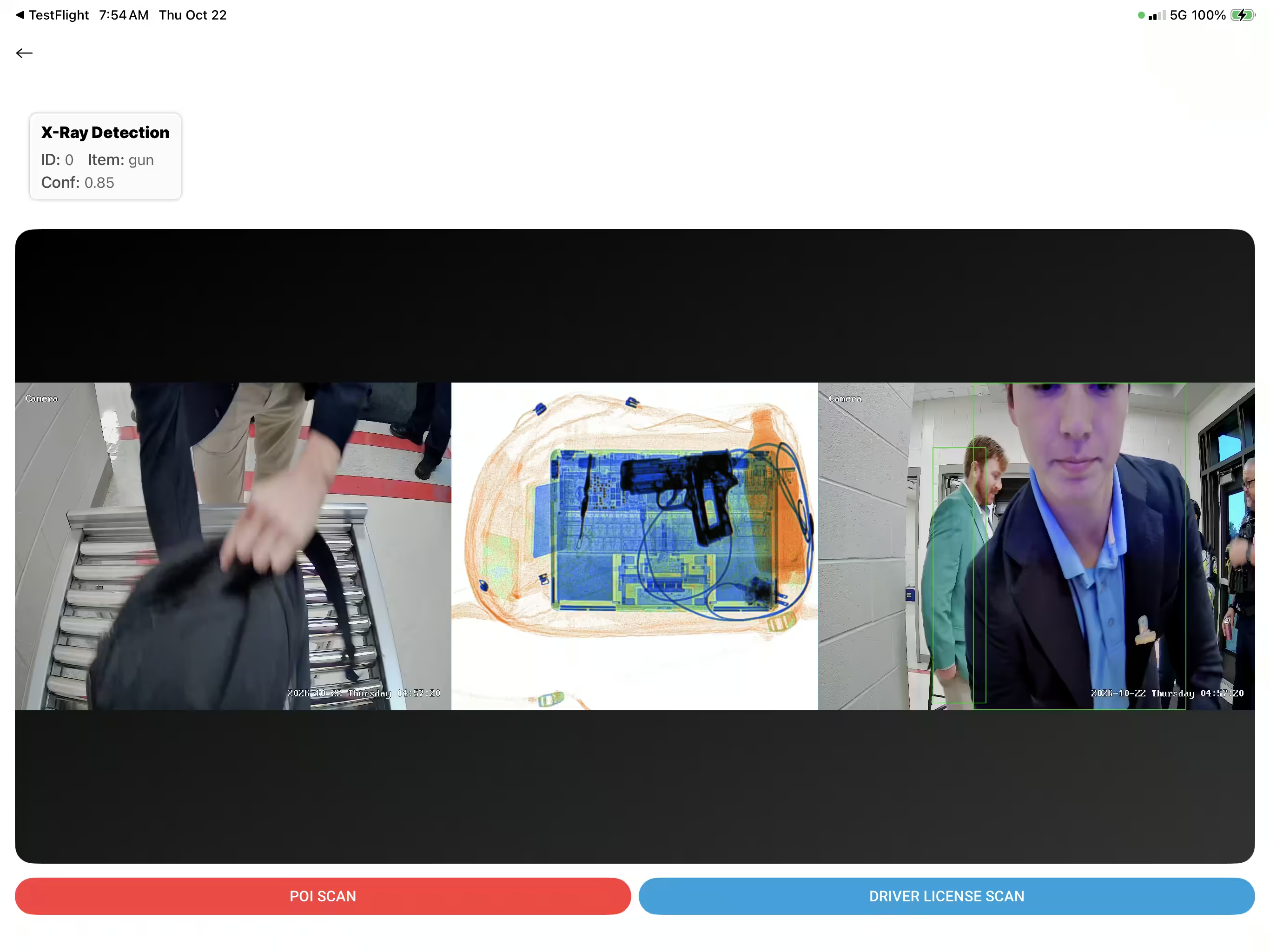
We’ve also recently launched bag-to-person identification in our A-Series X-Ray Baggage Scanner. This feature helps schools link bags to the individuals who presented them during entryway screening. So, the moment a student places their bag on the conveyor belt, our AI automatically captures three images: the bag’s exterior, the student’s face, and the internal X-ray scan.
All these images are unified in a single screening record (as shown in the image below). As a result, security teams can quickly trace the bag owners long after they’ve left the screening checkpoint.
Read More: K-12 School Security: How Layered Security Helps Schools Detect Weapons and Vapes
How Athena Security’s CWD Addresses the Challenges of Traditional Metal Detectors
Unlike traditional metal detectors (that detect only metal), our concealed weapons screening solution:
- Detects both metallic and non-metallic objects.
- Identifies whether the object is an actual weapon.
- Shows exactly where the weapon is located.
This helps your school detect weapons more accurately. Plus, officers no longer have to wand a student from head to toe or empty their backpack over a phone/binder. They only step in when the system flags a potential weapon. Even then, they go straight to the flagged spot and resolve it without a pat-down.
Our concealed weapons detection system is also safe for students and staff with pacemakers, as well as pregnant women. It uses low-frequency electromagnetic technology with non-contact detection. Third-party labs have tested it against ISO 14117 and EN 45502, medical device standards that cover pacemakers and implanted defibrillators.

2. Video and Camera Analytics for Surveillance
Video and camera analytics are AI software platforms that connect to your school’s existing surveillance cameras. They analyze live captured imagess to detect brandished weapons and suspicious behavior. These platforms can help extend your security layer beyond school entrances, into outdoor areas. So if someone draws a concealed weapon in a parking lot or on an athletic field, the system flags it before they reach a building.
Key features of video and camera analytics systems are:
- AI Gun Detection: AI software like Zeroeyes and Omnilert can continuously scan live surveillance feeds for geometric shapes that match shotguns, rifles, and handguns. They detect visible weapons the instant an individual draws them on school grounds.
- Human Verification: Every AI alert goes straight to a dedicated monitoring center. There, trained analysts or military and law enforcement veterans review the flagged video in real time. They filter out false alarms from objects like umbrellas or toys before an alert reaches your school.
- Rapid Emergency Dispatch: Verified threats trigger mass notifications to local police and campus administrators within three to five seconds. Alerts might include live camera links, the suspect’s physical description, and their exact geographic coordinates.
- Behavioral Video Analytics: AI software like VOLT can help schools analyze how people move to flag unusual loitering or perimeter breaches. It also picks up aggressive posturing and group dynamics, so security staff can step in before a physical confrontation escalates.
Note: Camera-based AI systems only catch visible weapons. They do not identify concealed ones. Many school districts in the United States, like Del Valle Independent School District, are now opting for AI-powered weapon detectors to solve this challenge.
If you are one such school, it’s worthwhile to check out these 5 Best AI Weapons Detection Systems for Schools.
3. Proactive and Administrative Systems for Early Threat Prevention
Targeted school attacks rarely come out of nowhere. According to the U.S. Secret Service’s study on 41 targeted attacks at K-12 schools, all attackers showed concerning behavior beforehand. The majority even communicated their intent to attack.
Proactive systems and administrative tools help your school catch these signals and prevent attacks.
Key systems in this category include:
- Anonymous Reporting Systems: Confidential software platforms let students securely report threats and warning signs, like bullying or mental health concerns. With these early tips, administrators can step in before an issue escalates into physical violence.
- Visitor Management Systems: These systems replace paper sign-in sheets with automated visitor screening. For example, our School Visitor Management System scans a visitor’s driver’s license and screens them against sex offender registries and criminal databases. The whole check-in, from license scan to printed photo badge, takes under 30 seconds. If a flagged individual tries to enter, school leaders get real-time alerts on their mobile devices.
- Access Control and Single-Point Entry: Electronic door locks, reinforced glass entryways, and secure visitor vestibules harden your school’s physical perimeter. They funnel all foot traffic through a single monitored entrance. Meanwhile, exterior doors stay locked during school hours to prevent unauthorized entry.
However, a student tip or visitor alert only helps if someone acts on it. The Secret Service recommends that schools form a multidisciplinary threat assessment team for this. This team can include administrators and school resource officers, who review reports of concern and assess the risk. The agency also advises having staff monitor your anonymous reporting system and follow up on every tip.
How to Choose the Right Alternatives to Metal Detectors (A Buyer’s Checklist)
To choose the right alternative for metal detectors at your school, you should run each option through this checklist:
- Non-Metallic Threat Detection: Can the system detect non-metallic weapons, like ceramic knives or 3D-printed guns?
- Small Weapon Detection: Does it catch small knives and blades without turning sensitivity up and slowing the line?
- Nuisance Alarm Rate: How often does it alarm on everyday items like phones and keys?
- Threat Location: Does it show officers exactly where a threat is on a student’s body or inside their bag?
- Backpack Screening: Can it find threats hidden under books and laptops in a packed backpack?
- Throughput Rate: How many students/backpacks can it screen per hour?
- Alert Resolution: Can officers resolve alerts without pat-downs or wanding?
- Student Privacy: Can it link a flagged bag to its owner without facial recognition or tracking students?
- Medical Implant Safety: Has it been third-party tested against medical device standards for students with pacemakers or ICDs?
- System Integration: Can it work with your existing screening hardware and visitor management system as part of a layered security setup?
- Staffing Needs: Can the officer monitor student and bag screening from a single screen?
While you might get these answers easily from a vendor’s website or sales call, we recommend you ask each vendor for a live demo or pilot at your campus. You’ll see firsthand how accurately the system catches weapons during the morning rush.
What Is Athena Security’s Philosophy for Weapon Detection in Schools
Athena Security’s philosophy is simple: your school’s entrances should keep weapons out while still feeling welcoming to students. To get there, we go beyond passive hardware to fast, discreet screening, guided by four principles:
- Prevention Starts at the Entryway: When our systems flag a weapon at the front entrance, officers can step in before it reaches a hallway or classroom. That head start gives your staff precious time to respond and prevent violence.
- Human Judgment Comes First: Our AI helps officers spot potential threats, but a trained officer decides what happens next. No AI-powered detection system is 100% accurate, so trained staff and clear safety protocols need to back up every alert.
- Screening Is One Part of a Bigger Plan: We treat AI weapon detection as one piece of your school’s security measures. It sits next to active shooter training, anonymous reporting, lockdown readiness, and visitor management.
- More Signals, Fewer False Alarms: Our systems combine low-frequency electromagnetic readings with thermal and LiDAR data, then use AI to analyze them. This multi-signal approach improves accuracy and reduces false alarms.
Our philosophy, along with other factors, also helped us rank first on Del Valle ISD’s evaluation of student safety screening systems. Here’s a snippet from their Board of Trust Meeting notes:
“Athena was selected from a list of qualified companies following a comprehensive review and ranking process. Based on criteria such as system performance, ease of deployment, maintenance, and cost-effectiveness, this vendor ranked at the top of the list. This initial purchase will allow the District to test and assess real-time application in a school setting before making recommendations for expanded deployment in the future.”
To bring this kind of concealed weapon screening to your school’s entrances, you can call us at +1-833-928-4362 or book a demo.
Frequently Asked Questions About Alternatives to Metal Detectors at Schools
As you decide which alternative to metal detectors best fits your school district’s security requirements, you may have a few questions. Below, we answer the most common questions around upgrading existing metal detectors, student data privacy in such systems, and funding.
If you have a specific question in mind, give us a call at +1-833-928-4362 to take it up with our experts.
1. Can a School Upgrade Its Existing Walk-Through Metal Detectors With AI Software Instead of Replacing Them?
Yes. Schools can add AI software to their existing walk-through metal detectors instead of replacing the hardware. For example, our hardware-agnostic AI layer integrates with walk-through metal detectors from major manufacturers like Garrett and Metrasens. So your school gets more value from equipment it already owns.
Once AI is layered onto your existing portals, they can detect threats in real time and flag anyone who bypasses screening using our patented AI Evasion Detection technology. Plus, security staff get a simple, intuitive console that speeds up morning entry.
2. What Security Protocols Does Athena Security Follow to Protect Student Data During Entryway Screening?
Our screening solutions follow specific legal, technical, and operational security protocols:
- FERPA Compliance: Athena Security acts as a “school official” with a legitimate educational interest under FERPA and operates under your school’s direct control.
- Data Ownership: Your school retains full ownership of all data and sets all retention/deletion schedules.
- No SIS Integration or Student Profiling: Our software doesn’t connect to Student Information Systems (SIS), student rosters, or student ID databases. Plus, we never sell student data or use it for marketing/AI training purposes.
- No Facial Recognition: We do not use facial recognition technology during school screening.
- On-Device AI Processing & Device-Side Encryption: AI detection runs locally on the screening device. Alert images are encrypted on the iPad console using encryption keys stored exclusively on the tablet.
- Encryption & Access Controls: All data is encrypted using AES-256 at rest and TLS 1.3 in transit on US-based cloud infrastructure. Access requires two-factor authentication. Alert notifications are sent via expiring, login-protected links.
You can read more about our student data privacy policy here.
3. How Can Schools Build a Weapons Screening Rollout Plan?
When building a weapons screening rollout plan for your school, follow the following steps:
- Start With Arrival Data From Your Busiest 15 to 30 Minutes: Measure how many students arrive in that window and how many carry bags. Also note how bad weather and late arrivals shift these numbers.
- Bring Stakeholders and Families In Early: Form a rollout committee with district security and school administrators. SROs can join too if they’re part of your response policy.
- Educate Parents and Caregivers Early: Before launch, families should also know which entrances to use and how to pack bags for screening. Also, explain what happens when an alert goes off.
- Run Separate Flows for Students and Bags: Students should walk through a weapons detection portal while their bags go through an X-ray scanner. This offers higher detection accuracy than portal-only setups.
- Staff Your Checkpoint With a 2+5 Model: Two security officers make security decisions, while five helpers keep students and bags moving. You can adjust the model to fit your entrance, but 2+5 is a strong starting point for maximum security.
- Write SOPs Before Going Live: Your SOPs should define which loose items, like laptops, can go around the detector instead of through the X-ray. They should also specify when officers notify administrators or law enforcement about an alert.
Learn more: How to Build a Weapons Screening Rollout Plan for School.
4. Can a School Safety Grant Fund Concealed Weapons Detector Portals and X-Ray Baggage Scanners for My School?
Yes. Federal and state school safety grant programs can help fund weapons detection systems, including:
- COPS School Violence Prevention Program (SVPP)
- STOP School Violence Program
- Indiana’s Secured School Safety Grant
But competition is tough. In 2023, SVPP funded only 206 of the 1,022 applications it received. Grants may also cap funding or exclude costs like staffing. So your application needs a clear budget that ties each expense to a real safety gap. Our step-by-step guide shows you how to build that case.
Read more about it here: How to Write a School Safety Grant Application for a Weapons Detection System.
5. How Can I Procure School Security Solutions from Athena Security?
To procure our school security solutions, you can book a free live demo below. Our experts will respond within 24 hours to understand your school’s security needs and demonstrate our security solutions. We’ll then conduct an on-site or virtual assessment of your school’s entrance layouts and peak traffic patterns before providing a customized quote.
You can also email us at [email protected] or call us at +1-833-928-4362.
Disclaimer: The images have been created using AI-based tools and are intended for illustrative purposes only. They may not accurately represent real individuals, locations, or situations. Any resemblance to real persons, living or dead, or actual events is purely coincidental.