
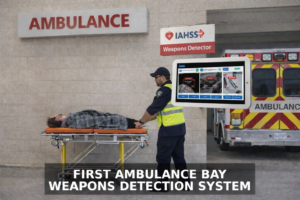
Hospitals have spent years strengthening security at public entrances, visitor check-in desks, and employee access points. Yet one of the most vulnerable areas in many healthcare facilities remains the ambulance bay.
Emergency entrances operate under entirely different conditions than standard hospital access points. Patients arrive unconscious, injured, unstable, or in critical condition. Staff members often have only seconds to act. In these situations, traditional security procedures can become nearly impossible to implement without interfering with urgent medical care.
As workplace violence in healthcare continues to rise nationwide, many hospitals are beginning to reevaluate how emergency intake areas are secured. Healthcare workers experience workplace violence injuries at significantly higher rates than workers in most other industries, according to both the Occupational Safety and Health Administration (OSHA) and The Joint Commission.
The challenge is especially serious in emergency departments, where hospitals regularly treat trauma victims, violent offenders, psychiatric patients, and individuals involved in gang-related incidents. Weapons may enter facilities through ambulance entrances simply because existing screening methods were never designed for emergency medical workflows.
Most conventional weapons screening systems rely on metal detection. While these systems can work effectively at public entrances, ambulance bays present a completely different operational environment. The biggest obstacle is the stretcher itself. Medical stretchers and gurneys contain significant amounts of metal, causing traditional metal detectors and handheld wands to trigger constant alarms. Security personnel often cannot easily distinguish between harmless medical equipment and an actual concealed weapon.
At the same time, emergency responders cannot realistically stop critical patients for lengthy manual searches during life-threatening medical situations. In trauma cases, delaying treatment by even a few minutes may create serious consequences for patient outcomes.
Historically, hospitals had limited options for effectively screening patients arriving via stretcher without disrupting emergency care workflows. That gap has created a longstanding “blind spot” in hospital security infrastructure.
Violence in healthcare settings has become a major operational and financial concern across the United States.
According to the U.S. Bureau of Labor Statistics, healthcare and social assistance workers accounted for nearly 73% of all nonfatal workplace violence injuries requiring days away from work in private industry.
The financial impact is also substantial. The American Hospital Association has warned that workplace violence creates billions of dollars in annual costs through staff injuries, turnover, legal exposure, security spending, and operational disruption. Emergency departments remain among the highest-risk environments. Violent incidents involving patients, visitors, or accompanying individuals frequently occur in ERs, psychiatric units, waiting rooms, and trauma centers.
Recent high-profile incidents have intensified scrutiny around hospital security failures. In some cases, healthcare workers and officers have been attacked by patients who entered facilities with undetected weapons. Hospitals nationwide are increasingly investing in stronger violence prevention measures as regulators and healthcare organizations push for more proactive security standards.
As the threat environment evolves, hospitals are beginning to adopt weapons detection systems designed specifically for emergency intake environments. One emerging approach uses imaging radar wave technology combined with artificial intelligence to screen patients arriving by stretcher without relying on traditional magnetism-based detection systems.
Unlike standard metal detectors, radar imaging systems are designed to detect concealed objects beneath clothing while filtering out interference caused by medical equipment and stretchers. Athena Security has developed an Ambulance Bay Concealed Weapons Screening System specifically built for this workflow.
The system uses:
The screening process is designed to minimize disruption to emergency medical operations.
As patients arrive at the ambulance bay, personnel can guide the stretcher through the scanning area at normal walking speed. Patients do not need to stand, reposition themselves, or actively participate in the screening process.
The AI system analyzes scan data in real time, differentiating between medical equipment and potential threats such as firearms or large knives. Operators receive a visual interface highlighting the approximate location of suspicious objects on the body.
This allows hospitals to conduct security screening during emergency intake without significantly delaying treatment timelines.
Modern weapons detection systems are also evolving beyond simple alarm activation. Some systems now include integrated documentation capabilities that allow hospitals to create digital audit trails tied to screening events. Operators may log patient information, document confiscated items, and generate property receipts directly through the interface.
These features can help support chain-of-custody procedures, property handling protocols, and internal compliance documentation. For healthcare administrators, the combination of security visibility and operational accountability is becoming increasingly important as workplace violence prevention regulations continue expanding.
California’s AB 2975 reflects the growing momentum behind stronger hospital violence prevention requirements. The legislation expands workplace violence prevention expectations for hospitals and increases focus on weapons detection screening policies at healthcare facilities. The law follows years of growing concern surrounding assaults against healthcare workers and mounting pressure for hospitals to strengthen physical security infrastructure.
The Joint Commission has also expanded workplace violence prevention standards in recent years, requiring hospitals to implement more comprehensive violence prevention programs, incident tracking systems, and staff protections. As regulatory expectations evolve, emergency entrances may receive far greater scrutiny than they have historically.
Hospitals face a difficult balancing act. Emergency departments must remain fast, accessible, and patient-focused while simultaneously protecting healthcare workers, officers, visitors, and patients from increasingly common security threats. For years, ambulance bays represented one of the hardest security challenges in healthcare because traditional weapons screening systems were incompatible with emergency medical workflows. New AI-powered screening technologies are beginning to change that equation. As workplace violence concerns continue growing nationwide, ambulance bay security may become one of the next major priorities in healthcare facility protection.
Works Cited
“Healthcare – Workplace Violence.” Occupational Safety and Health Administration (OSHA). Accessed 22 May 2026.
“National Performance Goal #2a: Preventing Workplace Violence.” The Joint Commission. Accessed 22 May 2026.
“Workplace Violence 2021–2022.” U.S. Bureau of Labor Statistics. Accessed 22 May 2026.
“The Burden of Violence to U.S. Hospitals.” American Hospital Association. Accessed 22 May 2026.
“Violence and Work.” Centers for Disease Control and Prevention (CDC/NIOSH). Accessed 22 May 2026.
Traditional metal detectors struggle to differentiate between medical metal stretchers and actual weapons, making accurate screening difficult during emergency intake.
New AI-powered radar imaging systems by Athena Security can screen patients while they remain on metal stretchers without interrupting emergency care workflows.
Emergency departments often treat trauma victims, psychiatric patients, violent offenders, and emotionally distressed individuals, increasing the risk of workplace violence.
Regulations vary by state, but workplace violence prevention standards from organizations like OSHA and The Joint Commission are increasing pressure on hospitals to improve security screening.