

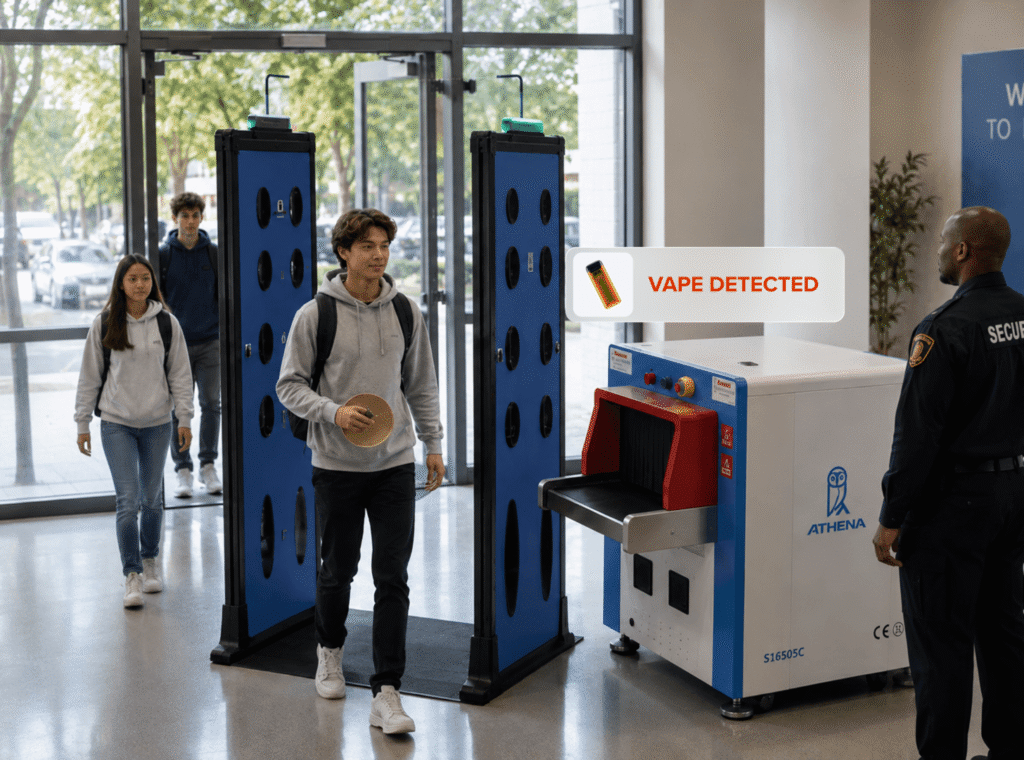
Schools today face growing security challenges that require more than a single checkpoint or isolated technology solution. From weapons entering school facilities and unauthorized campus access to contraband concerns that are highly prevalent such as vapes, K-12 administrators are under increasing pressure to create safer environments while preserving a welcoming and positive student experience.
The challenge is balancing safety with daily operations.
Students, faculty, parents, and visitors need to move through campus efficiently without creating an environment that feels intimidating, invasive, or disruptive to learning. Traditional screening methods often create bottlenecks, unnecessary physical contact, or inconsistent processes that can negatively impact both security operations and the overall school atmosphere.
That’s where a layered security approach becomes essential.
Why Schools Need More Than a Single Security Solution
Modern school security requires connected systems that work together to improve visibility, accountability, and situational awareness across campus. Main entrances, administrative offices, athletic events, performing arts venues, and other high-traffic campus locations all present unique operational and security challenges.
A layered approach helps schools address:
- Weapons entering school facilities
- Contraband detection including vapes
- Student, faculty, and staff safety
- Emergency response visibility
- Large event security management
Rather than relying on one technology or one screening process, schools need solutions designed to support both proactive threat detection and efficient day-to-day operations.
How Schools Detect Weapons Without Slowing Student Entry?
Athena Security’s platform is purpose-built to support K-12 school environments through high-throughput, weapons detection technology designed to minimize disruption to the school day.
The Apollo 500 Weapons Detection System delivers a fast, touchless screening experience capable of screening approximately one person per second depending on configuration. This allows schools to maintain efficient student entry during busy arrival periods, sporting events, and other high-traffic campus activities.
Unlike traditional metal detectors that simply trigger alarms, the Apollo 500 provides security personnel with actionable intelligence including:
- Threat localization
- Material composition context
- Real-time operator alerts
- AI-assisted threat identification
This means operators are not simply responding to an alert — they are receiving information that helps them make faster and more informed security decisions.
Built-in AI also helps reduce nuisance alarms by filtering out harmless everyday items such as keys, phones, and backpacks while maintaining focus on genuine threats.
While walkthrough weapons detection helps identify threats carried on individuals, schools also need visibility into backpacks, bags, and other personal belongings entering campus.
How Schools Screen Backpacks and Bags for Weapons, Vapes, and Contraband
Athena Security’s AI-Assisted X-Ray Baggage Scanner works alongside the Apollo 500 Weapons Detection System to create a unified and layered screening experience for K-12 campuses. Using dual-energy X-ray technology with AI-assisted analysis, the system helps identify weapons, vapes, alcohol, and more than 80 prohibited item categories relevant to school environments.
Available in multiple model sizes, the platform supports high-throughput backpack and bag screening with conveyor speeds up to 0.75 m/s and capacity of up to 2,000 bags per hour. Unlike standalone X-ray systems, Athena integrates baggage screening, weapons detection, secondary screening, incident reporting, analytics, and audit documentation into one centralized operator workflow managed through an Apple iPad interface.
Schools can also add extended exit conveyor configurations designed to maintain efficient student flow during busy arrival periods and large campus events.
The Growing Impact of Student Vaping
School administrators continue to face increasing challenges related to vaping and nicotine products. Vape devices are often designed to resemble everyday items, making them difficult to identify through visual inspection alone. As a result, many schools are looking for more effective ways to identify concealed vaping devices during routine screening operations.
How Can Schools Detect Vapes More Effectively?
Vaping continues to be one of the fastest-growing challenges facing K-12 schools. Students frequently conceal disposable vapes, nicotine devices, and electronic smoking products in backpacks, pencil cases, binders, and personal belongings. Traditional screening methods often struggle to differentiate vape devices from everyday electronics.
Unlike traditional object-recognition systems that primarily analyze shape, Athena’s AI-Assisted X-Ray evaluates multiple data points including atomic number, density, shape, and size. This allows the system to better distinguish vape devices from common student electronics and other personal belongings.
The AI X-Ray’s Technical Advantage
Traditional Systems
- Rely primarily on object recognition
- Can struggle when items are layered inside backpacks
- Limited ability to distinguish similar-looking electronics
Athena AI-Assisted X-Ray
- Analyzes atomic number, density, shape, and size
- Helps classify materials and electronic components
- Identifies concealed vape devices in cluttered bags
- Provides real-time alerts to operators
- Supports incident reporting and analytics
Benefits for Schools
- Improved vape detection capabilities
- Reduced reliance on manual bag searches
- More consistent screening processes
- Better enforcement of campus policies
- Increased operational visibility
- Incident documentation and reporting
- Supports a healthier learning environment
This approach helps schools address one of today’s most common student safety and disciplinary concerns while maintaining efficient entry operations and minimizing disruptions to the school day.
When weapons detection or bag screening identifies a potential threat, security teams need an efficient way to investigate and resolve alerts without creating unnecessary delays or invasive searches.
Why Secondary Screening Matters
Traditional secondary screening often relies on hand wands, manual bag searches, or physical inspections that can be inconsistent and time-consuming. Athena’s Secondary Screening WDS helps operators resolve alerts quickly while reducing the need for invasive searches and maintaining efficient student flow.
Secondary Screening WDS
When additional screening is necessary, Athena’s Secondary Screening WDS provides first-of-its-kind imaging radar technology designed to assist operators during alarm resolution.
The system helps schools:
- Verify alerts more efficiently
- Maintain consistent screening procedures
- Reduce unnecessary invasive searches
- Improve documentation and accountability
- Support professional and age-appropriate screening processes
This technology is designed to augment operators with additional awareness while keeping final security decisions in human hands.
Supporting Compliance, Reporting, and Operational Oversight
Beyond hardware, Athena provides schools with operational tools designed to improve documentation, reporting, and visibility across campus security programs.
The platform includes:
- DHS best-practice workflows
- Automated compliance reporting
- Prohibited item logging
- Audit documentation
- Security analytics
- Centralized operational oversight
All accessible through a connected Apple iPad operator interface designed for real-world security operations.
Building Safer Schools Without Disrupting Learning
School safety should not come at the expense of the student experience.
Effective school security is not about relying on a single device or checkpoint. It is about creating multiple opportunities to identify threats, resolve alerts, and maintain visibility across campus operations.
School safety requires more than a single security device. Today’s K-12 environments must address weapons, vapes, unauthorized access, contraband, and operational visibility while maintaining a welcoming learning environment. By combining weapons detection, AI-assisted bag screening, vape detection capabilities, secondary screening, and centralized reporting, schools can create a layered security strategy designed to improve safety without disrupting the student experience.
Athena Security’s layered security platform is designed to help schools strengthen campus protection while maintaining efficient entry operations and welcoming learning environments. Whether supporting a middle school, large high school campus, district facility, performing arts venue, or athletic event, Athena helps schools improve visibility, accountability, and proactive threat detection through a connected, layered security platform.
Frequently Asked Questions
Can X-ray scanners detect vapes?
Athena’s AI-Assisted X-Ray evaluates multiple data points including atomic number, density, shape, and size to identify vapes.
What is a layered school security approach?
A layered approach combines weapons detection, bag screening, secondary screening, operational oversight, and security analytics to create multiple opportunities to identify threats.
How can schools improve campus safety without slowing student entry?
Modern AI-powered screening systems help schools maintain high throughput while reducing manual searches and bottlenecks.