
For years, the healthcare visitor desk in most hospitals has been treated as a hospitality function. Someone signs in, gets a sticker, and walks to the elevator. The record, if there is one, lives in a binder or a spreadsheet nobody opens again. As of today, that changes for every general hospital in New York.
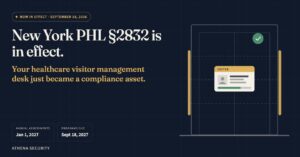
Public Health Law §2832 is now in effect. It requires general hospitals and nursing homes to establish formal workplace violence prevention programs designed to protect healthcare workers, patients, residents, and visitors. The deadlines roll out in stages:
The assessment is where a healthcare specific visitor management system enters the picture. New York specifically identifies a visitor management system and access control as factors hospitals must consider when evaluating their workplace safety and security. The law also requires hospitals to share redacted incident log summaries, trends, and analysis with the security or safety committee responsible for workplace violence, and to make that data part of the assessment itself.
In other words, the state expects hospitals to know who is coming through their doors, and to be able to show their work.
An assessment is only as good as the data behind it. If a hospital’s answer to “how do you manage visitor access?” is a sign-in sheet and a security guard’s memory, the assessment will reflect that.
A healthcare focused visitor management system gives a security team a defensible, time-stamped record of:
Each of those data points maps directly to questions a safety committee will need to answer under §2832. How many visitors were denied entry last quarter, and why? How often did security have to intervene at the entrance? Are restricted individuals actually being stopped? Are expired badges being caught?
Without a system, those are opinions. With one, they’re metrics. And metrics are what turn “we believe our procedures are working” into “here is what happened at our doors, and here is what we changed as a result.”
The hospitals that will have the easiest time with §2832 are the ones that stop thinking of the entrance as a checkpoint and start thinking of it as an instrument. Every interaction at the door, whether a routine visitor check-in, a denied entry, or a weapons detection alert, is a data point that feeds the annual assessment and the plan that follows.
That’s the approach we’ve taken at Athena Security. Our platform pairs healthcare visitor management with AI-powered weapons detection at the entrance, so the same checkpoint that screens for threats also:
The goal is not to add friction to the lobby. It’s to make sure that when the assessment comes due, the security team is pulling from real access data rather than anecdotes.
New York hospitals have until September 2027 to have a full program in place, and the first annual assessment is due in just over three months. That’s enough time to get this right, but not enough to leave it for next year’s budget cycle.
If your facility is building its 2027 assessment plan and wants to see what a documented, layered entry point looks like in practice, we’d welcome the conversation.
Sources
This post is for general information and does not constitute legal advice. Hospitals should consult counsel regarding their specific obligations under PHL §2832 and §2832-a.