
| Summary:
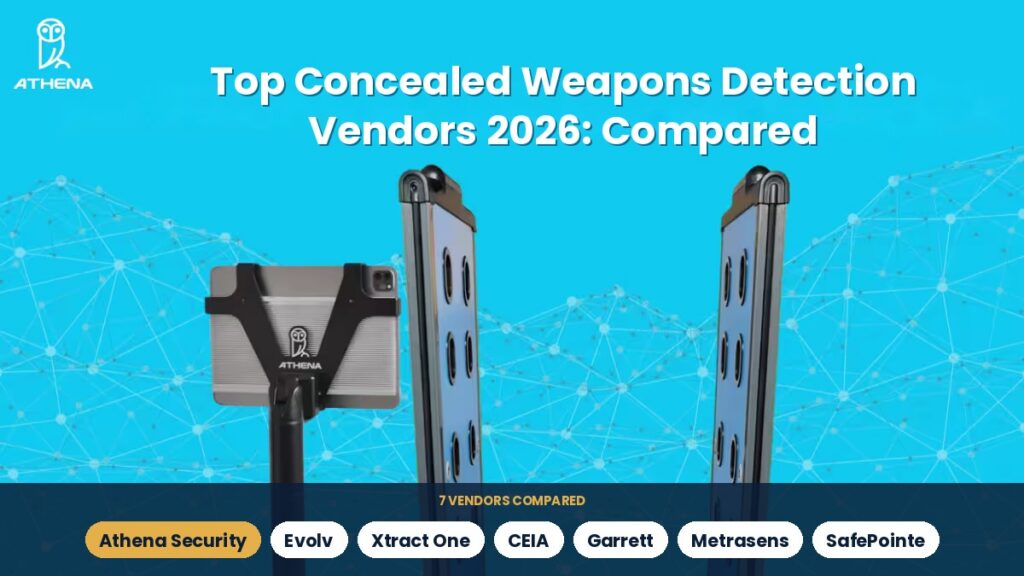
Not every weapons detection system senses the same way, and that difference matters more than the brand name. This guide compares the seven concealed weapons detection vendors buyers most often evaluate in 2026: Athena Security, Evolv, Xtract One, CEIA, Garrett, Metrasens, and SoundThinking SafePointe. For each vendor, the guide covers the sensing technology (active electromagnetic, passive magnetic, or hybrid), what it does well, and where buyers should probe before signing. It includes:
Every vendor claim was checked against the manufacturer’s current public pages and against DHS SAVER, NIJ, ASTM, NIST, and peer-reviewed sources listed at the end. Claims that could not be confirmed from a primary source were removed. This guide is published by Athena Security and includes Athena products; test every system, Athena included, against your own threat objects on your own site.
|
Technologies, strengths, limitations, operator workflow, compliance, data, and enterprise capabilities
Updated and source-verified: September 10, 2026. Vendor statements were checked against each manufacturer’s current public pages and against government and standards-body sources listed at the end.
What are the top concealed weapons detection vendors in 2026?
The concealed weapons detection vendors most buyers evaluate in 2026 are Athena Security, Evolv Technology, Xtract One, CEIA USA, Garrett Metal Detectors, Metrasens, and SoundThinking SafePointe. These systems do not all use the same sensing physics, and that difference matters as much as the brand name. The U.S. Department of Homeland Security’s SAVER program groups walk-through screening products into active electromagnetic metal detectors, passive magnetic detectors, and imaging or radar systems, and notes that active detectors can sense both ferromagnetic and non-ferromagnetic metals while passive systems generally struggle with non-ferromagnetic metals such as aluminum, copper, brass, and zinc. [3]
Buyer rule: compare the threat target, sensing method, security setting, real alarm rate, required divestment, secondary-screening burden, usable data, and what happens after the alert — not just the maximum people-per-hour number. DHS SAVER states plainly that the performance information in its market survey was supplied by manufacturers and was not independently verified; the same caution applies to every vendor claim in this guide, including Athena’s. [3]
Vendor Weapons Detection System technology comparison
|
Vendor / product |
Core approach |
Strong fit |
Key limitation / question to test |
|
Athena Security Apollo 500 |
Multi-frequency active electromagnetic detection + cameras + software platform |
Metallic threats, on-body localization, multi-site platform, layered security (X-ray, Healthcare Visitor Management System, access control, Ambulance Bay single purpose WDS) |
Purely nonmetallic threats need another layer; test the knife target at the intended security setting |
|
Evolv Express |
Active electromagnetic sensing + cameras + AI classification |
High-throughput, firearm-focused pedestrian screening |
Evolv states Express was designed for high-confidence firearm detection and that knife detection varies with size, shape, and metal; 2024 FTC settlement over past marketing claims |
|
Xtract One SmartGateway / Gateway |
Passive magnetic-field sensor arrays + AI classification |
High-throughput environments where people keep phones, bags, and laptops |
Performance depends on an object’s measurable magnetic signature; passive sensing is weaker on non-ferromagnetic metals — test the exact bag, laptop, and knife mix |
|
CEIA OPENGATE |
Active electromagnetic detection, two wire-free pillars |
Portable, fast-deployment metallic-threat screening; built-in ASTM F3566-22 security levels |
CEIA’s stated design target is mass-casualty metal threats (long guns, IEDs, handguns); small blades and nonmetallic items are outside that stated scope |
|
Garrett Paragon |
Multi-zone active electromagnetic metal detection (66 zones) |
Configurable sensitivity, smaller-metal detection, government and courthouse entrances |
More sensitivity generally means more nuisance alarms and more divestment; metal detection is not weapon identification |
|
Metrasens Ultra |
Passive ferromagnetic detection |
Ferromagnetic threats and contraband in specialized environments (behavioral health, corrections, data centers) |
Non-ferromagnetic metals and nonmetallic objects may be weak or invisible to a passive ferromagnetic sensor |
|
SoundThinking SafePointe |
Passive magnetic-moment sensing + 3D camera + edge AI + remote human analyst review |
Free-flow, bollard-style screening at large public entrances |
SoundThinking defines its target as a metallic firearm or a metallic knife with a blade of 4 inches or more; alerts route through a remote review center |
1. Athena Security Apollo 500
Athena Apollo 500 uses multi-frequency active electromagnetic sensing. A transmitter creates fields across the screening zone; metallic objects perturb those fields, and receivers measure the changes. Multiple frequencies and multiple zones provide more information than a single binary metal threshold. Athena combines the event with camera imagery, threat localization, operator workflow on a portable tablet console, testing records, incident reporting, and enterprise analytics. The Athena platform is hardware-agnostic and can connect selected third-party walk-through detectors, including CEIA, Garrett, and Metrasens Ultra units a facility already owns. [1][2]
What this weapons detection does well
- Strong at metallic firearms and knives when configured appropriately for the target
- Threat-location / zone information can focus secondary screening on a body region
- Can be paired with Athena X-ray, visitor management, access control, and enterprise reporting
- Hardware-agnostic platform can support selected third-party WDS hardware
Where Weapons Detection buyers should probe
Limitation: active electromagnetic sensing depends on how strongly an object interacts with the field. Pure ceramic, plastic, or other nonmetallic threats require complementary technologies — millimeter-wave or body imaging for on-person threats, or X-ray for bags. Athena publishes this limitation because the physics apply to every vendor in this guide, not just to competitors.
2. Evolv Technology — Express
Evolv Express combines active electromagnetic sensing, cameras, and AI. As people move through the lane, the system collects sensor information and can display a visual red-box localization to guide secondary screening. Evolv positions Express as a high-throughput system intended to reduce divestment compared with traditional high-sensitivity metal detection. [8]
What this weapons detection does well
- Strong for large-volume, firearm-focused pedestrian screening
- Visual localization and camera context for the operator
- Large deployment footprint across venues, schools, and healthcare
Where Weapons Detection buyers should probe
Knife limitation: as of September 2026, Evolv’s published FAQ states that Express was designed to deliver high-confidence detection of firearms, will also alert on some metallic knives, and that knife detection varies based on the size, shape, and metal in the knife. [9]
Regulatory history: in November 2024 the U.S. Federal Trade Commission announced a settlement with Evolv over allegations that the company made unsupported claims about what Express could detect and ignore. The FTC’s complaint alleged that Express scanners in schools failed in several instances to detect weapons while flagging items such as laptops, binders, and water bottles; it cited an October 2022 school incident in which a seven-inch knife reportedly was not detected, after which the school raised sensitivity and experienced a 50% false-alarm rate. The stipulated order, entered in March 2025, bars unsupported detection, speed, and labor-cost claims and gave certain K-12 customers that signed between April 2022 and June 2023 a 60-day option to cancel. Evolv disputed the allegations, admitted no wrongdoing, paid no monetary relief, and reported that 92% of eligible education customers kept their contracts. [10][11][12]
What this means for a buyer: the FTC action was about past marketing language, not a finding on the product’s core efficacy. The durable lesson is procedural — test the actual knife and firearm targets at the security setting you intend to run, and measure the nuisance-alarm rate at that setting before signing a multi-year contract.
3. Xtract One — SmartGateway and Gateway
Xtract One’s SmartGateway uses AI-powered passive magnetic-field sensor arrays. Rather than alarming on any metal object, it measures field changes across multiple coordinates, converts them to digital signals, and classifies them against trained weapon signatures. The company introduced a follow-on product, Xtract One Gateway, which it describes as using proprietary sensors and AI trained on thousands of walk-throughs to classify objects by size, shape, and material. Both are aimed at high-throughput settings where people retain phones, bags, and laptops. [13][14]
What this weapons detection does well
- High-throughput screening with minimal divestment
- Designed around real-world belongings and clutter
- Relevant to arenas, schools, workplaces, and healthcare; the company reports DHS SAFETY Act designation for its product suite
Where Weapons Detection buyers should probe
Limitation: passive magnetic sensing depends on the magnetic signature an object produces. DHS SAVER notes that non-ferromagnetic metals with low magnetic permeability are difficult for most passive detection systems. [3] Smaller, weakly magnetic, or nonmetallic threats therefore provide less useful sensor information. Buyers should test the exact bag, laptop, and knife mix at the intended security setting, and confirm which product (SmartGateway or Gateway) and software version is being quoted.
4. CEIA OPENGATE
CEIA OPENGATE uses active electromagnetic detection with two freestanding, self-powered pillars and no mechanical or electrical connection between them. CEIA describes it as the first fully wire-free active walk-through system. Current models add built-in ASTM F3566-22 Standard Security Levels, dedicated shoe-level threat detection, and LTE / Wi-Fi connectivity, with programming through a free iOS or Android app. [15][16]
What this weapons detection does well
- Portable, weatherproof, and fast to deploy — CEIA states setup in under a minute
- Good fit for events, schools, and temporary checkpoints
- Established electromagnetic detection pedigree and standards-referenced security levels
Where Weapons Detection buyers should probe
Limitation: CEIA’s own literature describes OPENGATE as designed to detect mass-casualty metal threats — high-caliber assault weapons and IED devices, up to full-size handguns — at very low nuisance-alarm rates. [15] That is a deliberate design choice, and it means small blades, box cutters, and any nonmetallic item are outside the product’s stated scope at its default security levels. Facilities whose threat matrix includes knives, dense bags, or vapes will need either a higher security level (with the divestment that implies) or a separate bag-screening layer. Enterprise workflow — alert images, incident records, and cross-site analytics — depends on the software connected to the unit rather than on the columns themselves.
5. Garrett Paragon
Garrett Paragon is a highly configurable active walk-through metal detector with 66 independent detection zones (left, center, and right across 22 horizontal bands), 200 sensitivity levels, and more than 23 pre-installed security programs. Garrett draws an explicit distinction between detection threshold and alarm threshold: the unit may sense a metal object even when the selected program does not alarm on it. Its Ambiscan feature allows different alarm thresholds for inbound and outbound traffic, and Quick-Q filtering suppresses signals from common items such as phones. [17][18]
What this weapons detection does well
- Many zones and sensitivity levels; precise on-body localization
- Good fit where smaller-metal sensitivity matters
- Useful for courthouses, government buildings, healthcare, and high-security entrances; conventional metal detectors of this type are the reference class for NIJ 0601.02 and ASTM F3566-22 testing [6][7]
Where Weapons Detection buyers should probe
Limitation: conductive metal detection is not semantic weapon identification. Increasing sensitivity to smaller blades typically increases ordinary-object alarms and divestment. DHS SAVER’s market survey found that conventional metal detectors and newer weapons-detection portals can achieve comparable throughput, so the real trade-off is between the alarm rate you accept and the staff you assign to resolve it. [3][4]
6. Metrasens Ultra
Metrasens Ultra uses passive ferromagnetic detection. It senses disturbances to the ambient magnetic field caused by ferromagnetic objects rather than transmitting its own field, locates a detected item to one of five body zones from head to toe (including footwear), and is available in freestanding, wall-mounted, and battery-portable configurations. Metrasens markets Ultra for corrections, data-center insider-threat screening, healthcare, and education, and the same core technology underpins the company’s MRI-safety ferromagnetic detectors. [19][20]
What this weapons detection does well
- Sensitive to ferromagnetic steel threats and small ferromagnetic contraband such as phones and blades
- Passive operation, portable, touchless screening at a distance
- Useful in behavioral health, corrections, education, and specialized layouts
Where Weapons Detection buyers should probe
Limitation: non-ferromagnetic metals and purely nonmetallic objects behave very differently from steel. DHS SAVER notes that non-ferromagnetic metals such as copper, aluminum, zinc, and brass are difficult for most passive systems to detect, and that non-ferromagnetic test objects are part of the NIJ 0601.02 standard for active walk-through detectors precisely because they matter. [3][7] The threat matrix must include the exact materials the organization needs to detect.
7. SoundThinking SafePointe
SafePointe combines passive magnetic-moment sensing in two bollards positioned 8 to 10 feet apart, a 3D camera, and an NVIDIA-powered edge processor. The bollards register the disturbance an object causes in the Earth’s magnetic field; the camera supplies direction, speed, and movement; and an on-device AI model makes an initial determination. Alerts are then routed to SoundThinking’s remote analyst review center, where staff review image and video and confirm or dismiss the alert, with the company stating a target of about 10 seconds. SoundThinking defines the weapons it targets as a metallic firearm or a metallic knife with a blade length of 4 inches or greater. [21][22][23]
What this weapons detection does well
- Open, free-flow architecture with no queue or checkpoint
- Combines magnetic data with 3D movement context and can screen multiple people at once
- Remote human verification reduces the alert load on on-site staff
Where Weapons Detection buyers should probe
Limitation: the target set is defined by SoundThinking as metallic firearms and metallic knives of 4 inches or more; smaller blades, non-ferromagnetic metals, and nonmetallic items are not within that definition. Because verification happens off-site, buyers should evaluate what happens in the seconds between an initial edge determination and the analyst confirmation — in particular, whether the person of interest has already passed the entrance — and how the facility’s own staff receive and act on the confirmed alert.
Why millimeter-wave and X-ray matter
Millimeter-wave personnel imaging solves a different problem from magnetic or electromagnetic WDS. It can reveal some metallic and nonmetallic objects under clothing, but clothing type, body geometry, pose, and occlusion can reduce visibility. NIST’s Security Technologies Group has demonstrated a passive 350 GHz millimeter-wave system imaging a ceramic knife concealed under a button-down cotton shirt, and NIST maintains research programs in both active and passive millimeter-wave security imaging. [24][25] A 2007 National Academies assessment concluded that no single sensor technology can cover the full range of concealed threats and that millimeter-wave imaging belongs inside a layered system of complementary sensors. [26]
Published research also documents the practical limits: cotton, synthetic, and blended fabrics are transparent to millimeter waves, wool partially attenuates them, and leather substantially blocks them; detection is also sensitive to subject rotation relative to the array. The body itself can block certain viewing angles, which is why multiple views and pose matter. [27] IEEE PN42.59 is the standard under development for measuring millimeter-wave security imaging performance. [4]
X-ray is the complementary layer for bags. A ceramic knife under clothing is a body-imaging problem; a ceramic knife inside a backpack is a baggage-imaging problem. ASTM F792 governs the imaging performance of security X-ray systems. A complete entrance may therefore need WDS + X-ray + body imaging where the threat assessment requires it. [6]
Weapons detection is also a data problem
A modern system should be judged not only by whether it alarms, but by how much high-quality, actionable information it produces. More raw data does not automatically mean better detection; more independent and meaningful measurements can give algorithms, operators, and executives more context. DHS’s SAVER TechNote is direct about the staffing reality behind every alarm: a portal may need one operator, but a screening lane can require three or more people — one to guide entrants, one to operate, and one to resolve alarms. [4] Data that shortens alarm resolution is therefore data that reduces headcount.
|
Real-time data point |
Why it matters |
|
Audio + visual alarm |
Immediate operator awareness |
|
Live operator console (portable tablet) |
Keeps alert handling in one workflow beside the checkpoint |
|
Alert image |
Visual evidence and context |
|
Threat-location box / body zone |
Focuses secondary screening on a body region |
|
Material / composition context where supported |
Adds information about the sensor response |
|
Confidence / threat score where supported |
Helps operators understand model certainty |
|
Visitor frequency / prior visits (with visitor management) |
Adds authorized identity context |
|
Prior weapon / prohibited-item history (with VMS) |
Adds authorized security context |
|
POI status (with VMS and policy controls) |
Adds authorized policy context |
What happens after the alert?
The FTC’s Evolv complaint and DHS SAVER’s staffing note point at the same gap: the alarm is the beginning of the work, not the end of it. The table below lists post-alert and compliance features buyers should ask every vendor to demonstrate. The right-hand column shows the Athena platform’s current support; competitor support for each item should be confirmed directly with the manufacturer.
|
Post-alert / compliance feature |
Why it matters |
Athena platform |
|
Document secondary screening |
Shows what officers actually found |
Yes |
|
Incident-report workflow |
Creates a structured post-alert record |
Yes |
|
Notes + images |
Provides auditable evidence |
Yes |
|
Threat-target test record |
Proves the station was tested against the desired target (see ASTM F3566-22 and NIJ 0601.02 test-object classes) |
Yes |
|
Station, setting, time, operator |
Makes test evidence useful enterprise-wide |
Yes |
|
Voluntary / turnaround workflows |
Measures deterrence, not just alarms |
Yes |
|
Bypass / evasion workflow |
Captures attempts to avoid screening |
Yes |
|
Unified WDS + X-ray alert view |
Reduces screen switching |
Yes |
|
Remote notifications |
Extends awareness beyond the checkpoint |
Yes |
|
Smart access-control logic |
Can hold access until an unresolved event is explicitly cleared |
Yes |
|
CSV / API / BI data access |
Supports enterprise analysis |
Yes |
|
Enterprise testing / settings view |
Shows what was tested and how units are configured |
Yes |
|
VMS integrations |
Connects screening events to the broader physical-security system |
Yes |
The smart access-control difference
Simple logic says: clear = unlock, alert = lock. A stronger workflow preserves the state of an unresolved alert. Example: a person puts a gun down, walks through clear, and then retrieves it. The access policy can be configured so the previous unresolved event still controls the door until an operator explicitly resolves it or a defined workflow completes. This turns access control into security event → policy logic → officer verification → access decision.
A note on weapons detection evidence in K-12 schools
Buyers should know that the peer-reviewed evidence base for entrance screening in schools is thin. A 2025 scoping review from the University of Michigan found only two empirical studies between 2005 and 2025 that met inclusion criteria for evaluating weapon-carriage interventions in U.S. K-12 schools, and it cautions that target-hardening measures can affect students’ perceptions of safety. [28] The NIJ-funded Johns Hopkins APL report on school safety technology remains the most comprehensive framework for planning a security infrastructure, and it treats weapons detection as one category among access control, communications, surveillance, and software. [29] None of this argues against screening; it argues for honest expectations, documented testing, and measuring what the system actually does after installation.
Bottom line For Weapons Detection System Vendor Selection
The top concealed weapons detection vendor is not necessarily the company with the largest marketing throughput number. Buyers should ask which platform can detect the threats in their threat matrix, at the intended security setting, with an acceptable real-world alarm rate — and then turn the resulting event into useful operator guidance, documented resolution, compliance evidence, integrations, and enterprise intelligence. Ask every vendor, Athena included, to demonstrate against your own test objects on your own site.
For entrance-by-entrance design, sensitivity, knife detection, X-ray, secondary-screening math, school arrival, hospital ED / ambulance-bay, and high-volume venue flow, see the companion guide: Hospital, School & Venue Weapons Detection Entrance Design Guide.
Chris — CTO & Co-Founder, Athena Security
Sources and verification links
Government, standards-body, and academic sources are listed first. Manufacturer pages are listed by vendor and were checked on September 10, 2026.
[1] Athena Security — Concealed weapons detection system
https://www.athena-security.com/concealed-weapons-detection-system/
[2] Athena Security — Hardware compatibility
https://www.athena-security.com/concealed-weapons-detection-system/hardware-compatibility/
[3] DHS S&T SAVER — Walk-Through Weapons Screening Systems for Mass Casualty Threats, Market Survey Report (Sept. 2024)
https://www.dhs.gov/sites/default/files/2024-09/24_0924_st_weaponsscreeningmsr_1.pdf
[4] DHS S&T SAVER — TechNote SAVER-T-TN-46, Walk-Through Screening Systems for Mass Casualty Threats (May 2024)
https://www.dhs.gov/sites/default/files/2024-05/24_0522_st_weaponsscreeningtechnote.pdf
[5] DHS S&T SAVER — Walk-Through Screening for Mass Casualty Threats, Focus Group Report (Nov. 2023)
https://www.dhs.gov/sites/default/files/2023-11/23_1101_st_weaponsscreening_fg_0.pdf
[6] ASTM International — Security system standards (F3566-22 walk-through metal detectors; C1238-24 installation; F2401-24 screening persons with medical devices; F792 security X-ray imaging performance)
https://store.astm.org/products-services/standards-and-publications/standards/security-system-standards-pedestrian-and-walkway-safety-standards.html
[7] National Institute of Justice — NIJ Standard-0601.02, Walk-Through Metal Detectors for Use in Concealed Weapon and Contraband Detection
https://nij.ojp.gov/library/publications/walk-through-metal-detectors-use-concealed-weapon-and-contraband-detection-0
[8] Evolv Technology — AI-based technology
https://evolv.com/ai-based-technology/
[9] Evolv Technology — Frequently asked questions (knife detection statement)
https://evolv.com/faqs/
[10] U.S. Federal Trade Commission — press release, FTC Takes Action Against Evolv Technologies (Nov. 26, 2024)
https://www.ftc.gov/news-events/news/press-releases/2024/11/ftc-takes-action-against-evolv-technologies-deceiving-users-about-its-ai-powered-security-screening
[11] U.S. Federal Trade Commission — FTC v. Evolv Technologies Holdings, Inc., case page with complaint and stipulated order
https://www.ftc.gov/legal-library/browse/cases-proceedings/evolv-technologies
[12] Evolv Technology — press releases on the FTC resolution (Nov. 26, 2024) and cancellation-period outcome (Mar. 31, 2025)
https://evolv.com/resources/press-releases/evolv-technology-announces-that-92-of-customers-eligible-to-end-contracts-elect-to-stay-with-evolv/
[13] Xtract One — SmartGateway
[14] Xtract One — Xtract One Gateway
[15] CEIA USA — OPENGATE product page
https://security.ceia-usa.com/products/opengate/
[16] CEIA USA — OPENGATE school security leaflet (specifications)
https://k12.ceia-usa.com/wp-content/uploads/2024/11/OPENGATE_SchoolSecurity_leaflet_DP060K0099v3000uUS-.pdf
[17] Garrett Metal Detectors — Alarm thresholds vs. detection thresholds explained
https://garrett.com/metal-detector-alarm-thresholds-vs-detection-thresholds-explained/
[18] Garrett Metal Detectors — Paragon walk-through metal detector
https://garrett.com/paragon-walk-through-metal-detector/
[19] Metrasens — Ultra (corrections / officer safety) product page
https://officersafety.metrasens.com/
[20] Metrasens — Data center electronics detection (Ultra)
[21] SoundThinking — Weapons detection (SafePointe overview and weapon definition)
https://www.soundthinking.com/security/weapons-detection/
[22] SoundThinking — SafePointe FAQ
https://www.soundthinking.com/faqs/safepointe-connect-faqs/
[23] SoundThinking — press release, Next Generation of SafePointe Weapons Detection System (Sept. 2024)
https://ir.soundthinking.com/news-events/press-releases/detail/296/next-generation-of-safepointe-weapons-detection-system-now
[24] NIST Security Technologies Group — Millimeter wave imaging (passive 350 GHz system; ceramic knife under cotton shirt)
https://www.nist.gov/mml/materials-measurement-science-division/security-technologies-group/millimeter-wave-imaging
[25] NIST — Sensing and imaging of concealed objects (program overview)
https://www.nist.gov/programs-projects/sensing-and-imaging-concealed-objects
[26] National Research Council (2007) — Assessment of Millimeter-Wave and Terahertz Technology for Detection and Identification of Concealed Explosives and Weapons
https://www.nationalacademies.org/read/11826/chapter/6
[27] Nature Communications / PMC (2024) — Towards large-scale single-shot millimeter-wave imaging for low-cost security inspection
https://pmc.ncbi.nlm.nih.gov/articles/PMC11291932/
[28] Stilwell et al. (2025) — Securing schools, protecting minds: a scoping review of limited evidence for weapon carriage prevention in K-12 schools
https://www.ncbi.nlm.nih.gov/pmc/articles/PMC12713219/
[29] Johns Hopkins University Applied Physics Laboratory — NIJ-funded comprehensive report on school safety technology (news release with report link)
https://www.jhuapl.edu/news/news-releases/180406b-johns-hopkins-apl-report-planning-school-safety-security-technologies
Disclosure: This comparison is published by Athena Security and includes Athena products. Competitor information was drawn from each manufacturer’s public materials and from the government and standards sources above, and should be verified directly with each manufacturer before purchase. Performance varies by object, material, orientation, security setting, environment, traffic, operator procedures, and software version. Organizations should independently test every proposed system against their own threat matrix.
Disclaimer:
The information provided in this article is based solely on publicly available sources and is intended for general informational and guidance purposes only. It should not be relied upon as a final decision-making resource or as a substitute for professional advice. While we strive for accuracy and completeness, we make no representations or warranties regarding the correctness, reliability, or suitability of the content. If you believe any information should be updated, corrected, or removed, please contact our team for review.