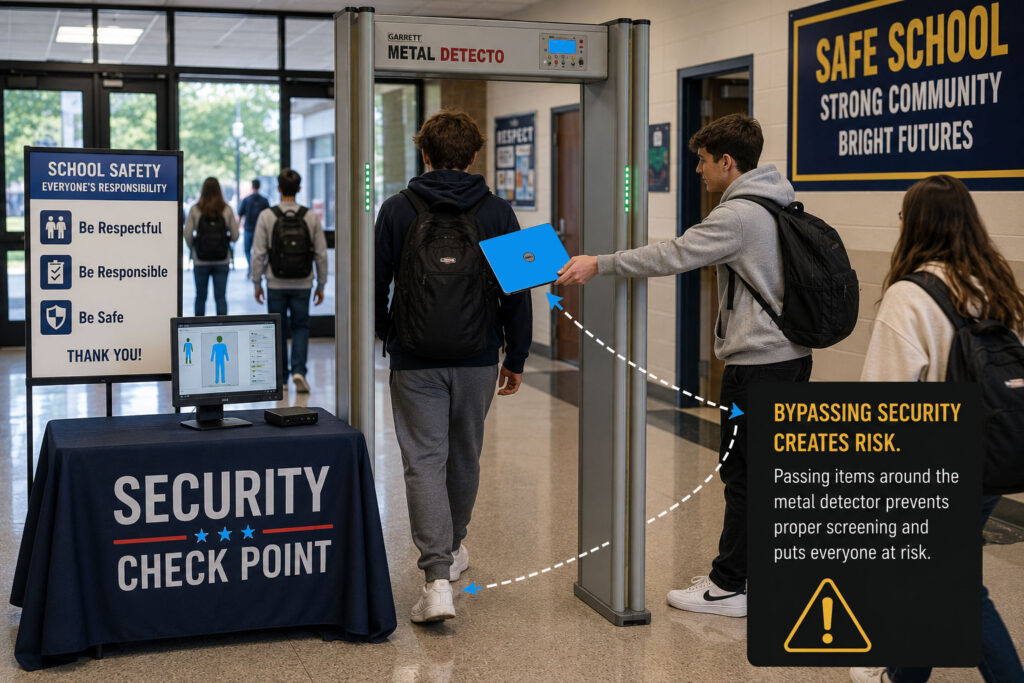

Many schools have adopted walk-through metal detectors to reduce the risk of firearms entering campus. However, an increasingly common practice undermines the effectiveness of these systems: allowing students to carry or pass laptops, iPads, bookbags binders, insulated bottles, lunch bags, or other containers around the metal detector while only the student walks through the screening portal due to speed of entry.
This practice creates a significant security vulnerability and a flaw in your security plan. While a walk-through metal detector is designed to detect metallic objects on a person, it cannot determine what is inside a backpack, laptop, thermos, or other carried item if that item bypasses inspection. As a result, schools may unintentionally create an opportunity for students to introduce firearms, knives, ammunition, or other prohibited items onto campus.
The layered security model used by airports, courthouses, hospitals, and federal facilities demonstrates the accepted best practice:
- Person screened by a walk-through metal detector
- Property screened by an X-ray inspection system
- Alarm resolution performed by trained personnel
Schools should follow the same principle rather than allowing property to bypass inspection.
The Security Gap Created by Passing Objects Around the Metal Detector
Walk-through metal detectors are designed to detect metallic objects concealed on a person’s body. They are not designed to inspect the contents of containers.
If a student walks through the detector while another student carries the student’s backpack around the detector, security personnel lose visibility into:
- Laptop compartments
- Large textbooks
- Musical instrument cases
- Thermos bottles
- Water bottles
- Lunch containers
- Pencil boxes
- Camera bags
- Athletic bags
Any of these items can conceal dangerous objects.
The result is simple:
The person was screened. The object was never screened.
Everyday School Items Can Conceal Weapons
Modern school backpacks and supplies provide numerous locations where weapons can be hidden.
Laptop Computers
Laptops contain:
- batteries
- cooling fans
- metal frames
- dense electronics
These naturally create clutter that can conceal:
- folding knives
- handgun components
- ammunition
- razor blades
- improvised weapons
Without X-ray imaging, security personnel cannot determine whether the laptop contains only legitimate electronics.
Insulated Water Bottles and Thermos Containers
Large insulated bottles have become extremely common in schools.
Examples include:
- Stanley
- Hydro Flask
- Yeti
- Thermos-style bottles
These containers:
- cannot be visually inspected externally
- often have double-wall construction
- may contain opaque liquids
- can conceal metal or non-metal objects
Opening every bottle individually dramatically slows screening and is rarely practical during morning arrival.
Backpacks
Backpacks commonly contain:
- textbooks
- binders
- laptops
- chargers
- clothing
- sports equipment
These items naturally overlap each other, making visual inspection unreliable.
An X-ray system allows officers to see:
- object shapes
- densities
- material composition
- concealed compartments
- overlapping objects
Hand Searches Are Not Equivalent to X-Ray Screening
Some schools rely on manual bag searches.
Unfortunately, manual searches have several limitations.
Time Pressure
Schools often screen hundreds or thousands of students in a short period
A complete hand inspection of every compartment is generally impractical.
Human Error
Security officers become fatigued.
Rushed inspections increase the likelihood of missing concealed objects.
No one checks all pockets of a bag.
Hidden Compartments
Many backpacks contain:
- false bottoms
- padded laptop sleeves
- hidden zipper pockets
- sewn compartments
These may not be discovered during a quick inspection.
Real-World Incident Demonstrates the Risk
A January 2025 incident at Albany High School illustrates the limitations of relying solely on metal detectors and hand bag inspections.
Two students were found with knives after an altercation inside the school.
School officials confirmed that both students had already passed through the school’s entrance security, which consisted of walk-through metal detectors and hand-searched bags. The district subsequently investigated how the weapons entered the school. Parents publicly called for the installation of X-ray systems for all bags because unidentified metal items were not being positively identified during screening.
This event demonstrates that:
- Screening checkpoints are only as effective as their weakest layer.
- Hand inspections performed under time pressure may fail.
- Parents recognized that bag X-ray screening provides a stronger layer of protection.
Weapons Can Also Be Passed Around Screening Checkpoints
Another concern is collusion.
Students may intentionally separate the weapon from the person.
Examples include:
- Student A walks through metal detector.
- Student B carries Student A’s backpack around the detector.
- Student C retrieves the backpack after screening.
Without screening the property itself, security personnel may never inspect the concealed weapon.
This bypass defeats the purpose of person screening.
Why Airports Never Separate People Screening from Property Screening
Airport security provides an established model used worldwide.
Passengers:
- walk through a metal detector or body scanner
- send all property through X-ray
No passenger is permitted to carry a backpack around the X-ray system.
The rationale is straightforward:
Even if the passenger is clear, the bag itself may contain a prohibited item.
The same security principle applies to schools.
Government Guidance Supports Layered Screening
The National Institute of Justice publication Appropriate and Effective Use of Security Technologies in U.S. Schools discusses walk-through metal detectors and X-ray baggage scanners as complementary technologies within a layered school security strategy.
Similarly, the U.S. Government Accountability Office explains that X-ray systems are used to inspect carried items while metal detectors inspect individuals because each technology addresses a different aspect of security screening.
These recommendations reflect decades of operational experience in transportation, government facilities, and critical infrastructure.
Advantages of Athena’s AI-Assisted Baggage X-Ray Scanners
Athena’s AI X-ray technology has advanced significantly beyond earlier generations.
Athena’s systems include:
- Dual-energy imaging
- Organic and inorganic material differentiation
- AI-assisted threat highlighting
- Automatic image enhancement
- Remote image review
- Operator training support
- Centralized monitoring
- High-throughput conveyor systems
These capabilities help security personnel inspect bags more efficiently while maintaining student flow.
Example of a School Entry Process
An effective screening process should include:
- Students place backpacks, laptops, binders, thermos bottles (no liquids), and other carried items onto the X-ray conveyor.
- Students walk through the metal detector.
- Security personnel resolve alarms as needed.
- Cleared students retrieve screened property.
- Secondary screening inspection is performed only when necessary using Athena’s new Secondary Screening WDS which is an advanced radar imaging technology capable of screening bags and personal belongings to help identify concealed threats while reducing the need for manual bag searches.
This process mirrors proven security practices used in other environments while maintaining efficient throughput.
Conclusion
Walk-through metal detectors / AI based weapons detection systems remain an important component of school security, but they are only one layer of an effective screening program.
Allowing Schools to Sacrifice Security for Speed is a big mistake as currently some are passing backpacks, laptops, binders, thermos bottles, or other containers to bypass inspection creates an avoidable security gap. These everyday items can conceal prohibited objects that cannot be identified by screening the individual alone.
A layered approach—combining walk-through metal detectors with X-ray screening of all carried property—provides a more comprehensive security strategy which allows security with speed. By screening both people and property, schools reduce opportunities for concealed threats to enter campus and align their procedures with established practices used in airports, courthouses, hospitals, and other security-sensitive environments.
References
- Green, M. W. (1999). Appropriate and Effective Use of Security Technologies in U.S. Schools. National Institute of Justice. https://nij.ojp.gov/library/publications/appropriate-and-effective-use-security-technologies-us-schools
- U.S. Government Accountability Office. National Preparedness: Technologies to Secure Federal Buildings (GAO-02-687T). https://www.gao.gov/products/gao-02-687t
- Times Union. Police: Albany High student charged after pulling knife at school. January 2025.
- U.S. Department of Homeland Security. Physical Security and Protective Measures guidance for layered security.
- U.S. Department of Education. Guide for Developing High-Quality School Emergency Operations Plans.
- Cybersecurity and Infrastructure Security Agency (CISA). K–12 School Security Resources.