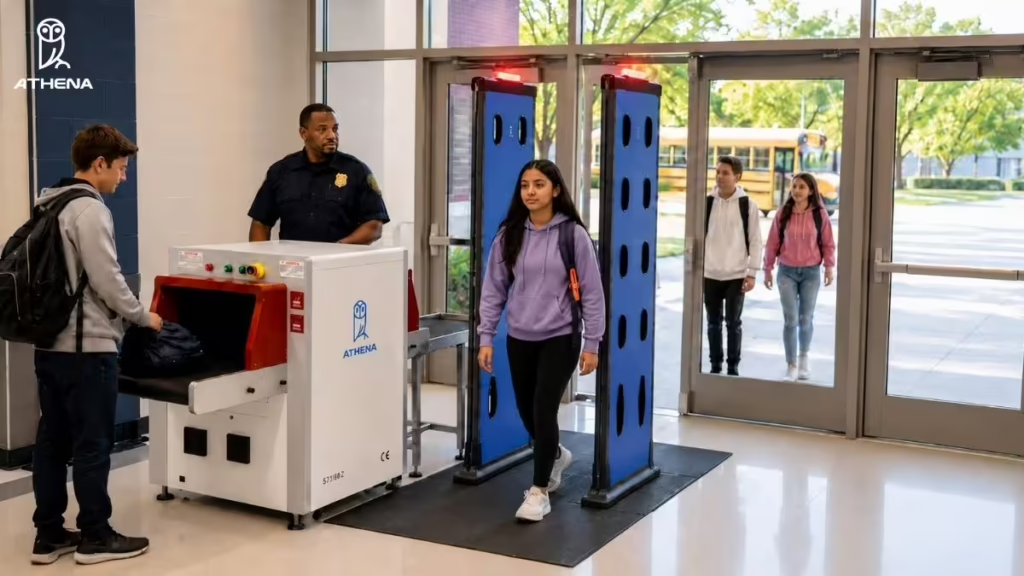

| TL;DR: To prevent knives and small weapons from entering school, use a weapons detection system to screen students, an X-ray baggage scanner to check bags, secondary screening to resolve alerts, and trained staff to manage entry during busy arrival hours. |
In May 2026, police took a Rolling Meadows High School student into custody after he allegedly threatened others while carrying two knives on school grounds. A month earlier, a Bourne High School student brought a folding pocketknife to school and allegedly pointed it toward other students during two verbal altercations.
Incidents like these show why schools need a stronger way to prevent knives and small weapons from entering campus. These objects can be carried on the person, placed inside backpacks, or missed when screening is tuned only for speed. For bags, schools also need enough X-ray context to identify small weapons hidden among books, electronics, lunch items, and daily supplies.
Human supervision alone cannot solve that problem.
Schools need a screening workflow that helps staff identify small weapons before they enter the building. This is what this guide is about. In this guide, we’ll explain how to prevent knives and small weapons from entering school while keeping student entry fast, organized, and safe.
Why Are Knives And Small Weapons Hard To Stop At School Entrances?
Knives and small weapons are hard to stop because they are compact, easy to conceal, and can be carried either on the person or inside bags. That is why some schools are already trying stricter bag rules.
In one Reddit discussion, a high school staff member shared that their school has a “no backpacks” policy and requires students to keep backpacks in lockers. That kind of policy shows how seriously schools are thinking about bag-related risks.
But bag restrictions alone do not solve the entrance problem.
Here is why:
- Students still enter with everyday items: Lunch bags, laptops, binders, sports gear, instruments, and personal items can still create screening challenges.
- Small weapons can be carried on the person: A policy focused only on backpacks may not catch items carried in clothing, shoes, or pockets.
- Bags still need a screening plan: A small knife, vape, or dense metal object can sit among books, electronics, lunch items, and sports gear. Schools need more than a basic visual check to understand what is inside the bag.
- Morning arrival creates pressure: Schools need to move students quickly without weakening detection. This can create a scenario where a knife or smaller weapon might be missed in a manual check.
- Speed can weaken security: If sensitivity is lowered just to reduce alerts, smaller weapons may become easier to miss.
Bag rules may reduce one risk, but they do not replace entrance screening. Schools still need a workflow that checks both students and belongings before they enter the building. Now lets discuss the best ways to prevent knives and small weapons from entering schools.
What Is The Best Way To Prevent Knives And Small Weapons From Entering School?
The best way to prevent knives and small weapons from entering school is to use a weapons detection system to screen students and what they might be carrying on them, use an X-ray baggage scanner to check bags separately, set up secondary screening to resolve alerts, and have at least one trained staff member manage the process.
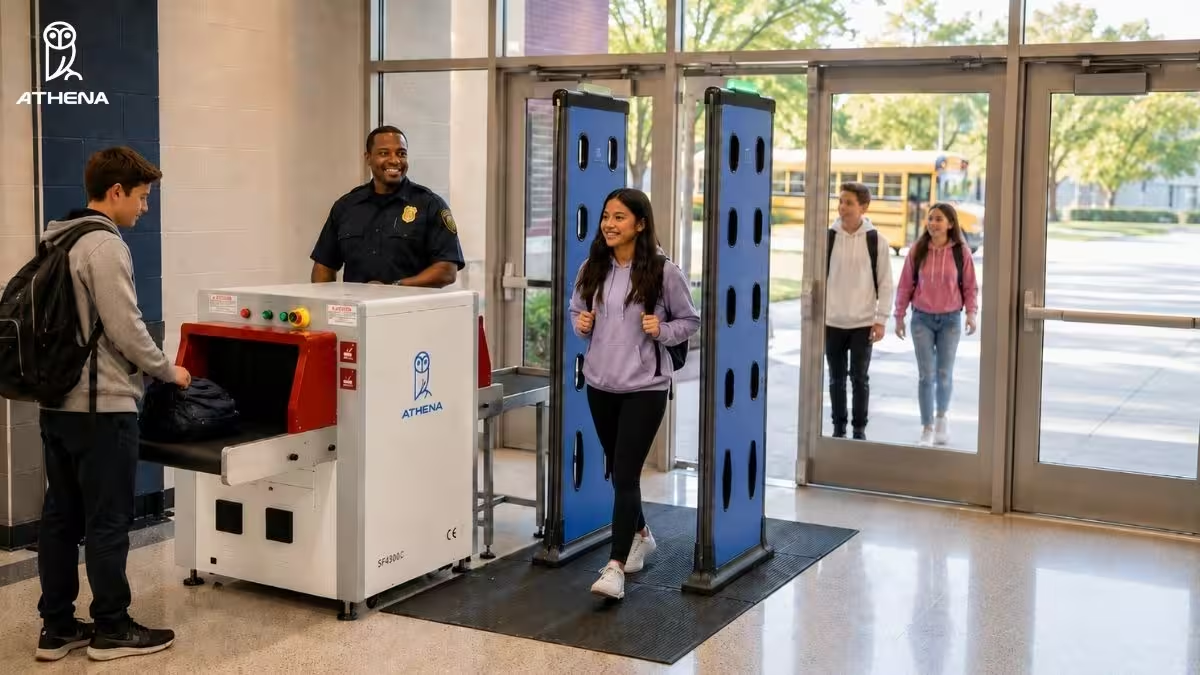
Here’s how it will play out in a real school environment:
| School Entrance Problem | What Solves It |
| Small weapons may be carried on the person | A walkthrough weapons detection system screens students as they enter |
| Knives or sharp objects may be hidden inside backpacks or lunch bags | An X-ray baggage scanner checks bags separately from the student flow |
| Small weapons may be hidden among books, electronics, lunch items, and school supplies | Dual-Energy X-ray helps staff review both the shape and material makeup of items inside the bag |
| Bag-related alerts can slow down the full entrance line | Secondary screening moves only flagged students or bags out of the main line |
| Teachers or staff may not know how to respond after an alert | At least one trained staff member manages alerts, secondary checks, and escalation |
| Schools may lower sensitivity to keep students moving | Separating people screening from bag screening helps maintain stronger detection without creating long lines |
For example, a school using Athena’s Apollo weapons detection system and Athena’s AI X-ray baggage scanner can split the entrance flow into two parts. A student places their backpack on the X-ray scanner, then walks through Apollo. Apollo screens the student, while the AI X-ray baggage scanner checks the bag.
Athena’s AI X-ray baggage scanner uses Dual-Energy X-ray, atomic number data, material density, and material type to give staff more context than shape alone. This helps operators review small knives, dense metal objects, vapes, and other suspicious items that may be hidden among everyday school supplies.
If neither system flags anything, the student collects the bag and enters. If Apollo or the X-ray scanner flags something, staff can move that student or bag into secondary screening instead of stopping the entire entrance line.
Why Does This Setup Work Better Than Using Only A Walkthrough System To Prevent Small Weapons?
This setup works better because students and bags create different screening problems.
A walkthrough weapons detection system is useful for detecting knives and small weapons carried on the person. But bags introduce more variables, such as laptops, binders, lunch boxes, sports gear, books, chargers, and other everyday school items.
If a school tries to screen students and bags through one walkthrough lane, it usually runs into one of two problems:
- Keep sensitivity high, and the school may see more alerts, longer lines, and slower morning entry.
- Lower sensitivity for speed, and smaller weapons may become easier to miss.
Adding X-ray solves this by separating person screening from bag screening. Apollo focuses on the student. The X-ray scanner focuses on the bag.
That is why schools should not treat X-ray as an optional add-on if they want both stronger detection and smoother entry flow. If neither system flags anything, the student collects the bag and enters. If Apollo or the X-ray scanner flags something, staff can move that student or bag into secondary screening instead of stopping the entire entrance line.
How Does Athena Apollo 500 Detect Small Knives On A Person?
Apollo 500 detects small knives by looking for metal objects on a person as they walk through the system.
Here’s how it works in simple terms:
- The system creates a detection field around the person.
- When a metal object passes through that field, the system senses a change.
- Apollo 500 evaluates that change to understand the object’s size, shape, and metal type.
- It’s built-in AI helps decide whether the object looks like a possible threat or a harmless everyday item.
This helps Apollo 500 detect small-edged weapons, including 2 to 2.5-inch blades and razor blades, that simpler systems may miss.
How Does Athena AI X-Ray Baggage Scanner Detect Small Weapons Inside Bags?
The AI X-ray baggage scanner helps staff see what is inside backpacks, lunch bags, sports bags, and other carried items without opening every bag.
It uses dual-energy X-ray, which means it looks at objects in two ways: by their shape and by what they are made of. Athena’s system also uses atomic number data, material density, and material type to give staff more information than shape alone. This helps staff review items that may be hidden under books, clothes, electronics, or other school supplies.
It can help identify:
- Knives
- Vapes
- Dense metal objects
- Non-metallic or non-ferrous weapons
- Suspicious items inside backpacks, lunch bags, or sports bags
Here’s how it works:

This matters because a small weapon inside a bag may not be easy to spot by shape alone. The scanner gives staff a clearer image and more information before they decide what to do next.
Will The System Confuse A Small Knife With A Fork Or Charging Cable?
Athena’s systems are designed to reduce unnecessary alerts from harmless everyday items, but every flagged object should still be reviewed by a trained staff member.
Apollo 500 does not only ask, “Is there metal?” It looks at details such as:
- How large the object is
- How heavy or dense it appears
- What shape it has
- What type of metal it may be
- Whether it looks like a possible threat
The AI X-ray baggage scanner helps staff review the object’s material and density, so they can better tell the difference between a possible weapon and a harmless item like a fork, key, or charging cable.
What Happens If Apollo 500 Flags A Possible Knife?
If Apollo 500 flags a possible knife, the operator receives an alert on a tablet or AR Alert Glasses (if they have).
The alert can help staff see:
- Where the possible threat is located
- Whether the concern is with the person or with a carried item
- Where to focus the secondary check
Instead of searching randomly, they can check the area that needs attention. This helps staff resolve the alert faster without stopping the full entrance line.
Watch the video below to see how this works:
What Happens If The X-Ray Scanner Flags A Possible Knife Inside A Bag?
If the AI X-ray baggage scanner detects a possible threat inside a bag, the conveyor belt stops with the bag inside the scanner.
The operator receives an alert on an iPad and can review:
- A clearer X-ray image
- The area where the possible threat appears
- A closer view using zoom and crop controls
- Details that help decide whether the item needs follow-up
If the on-site operator is unsure, the image can also be reviewed remotely through Athena’s cloud-based Second Look AI analysis. It is used as an additional review layer for cleared bag scans. Its purpose is not to confirm every object already detected on-site, but to help catch a possible threat that the first AI review may have missed.
Why Does Human Supervision Still Matter?
Human supervision matters because schools need a safe and consistent way to confirm alerts before taking action.
Athena’s system can help staff:
- Detect suspicious objects
- Highlight possible threats
- Show where the issue may be
- Review bag contents through X-ray
- Move unclear cases into secondary screening
But trained staff still need to confirm what the object is and follow the school’s response process.
That is why the best prevention setup is a full workflow that combines Athena Apollo 500, Athena AI X-ray baggage screening, secondary screening, and trained staff response.
What to Do If A Knife Or Small Weapon Is Flagged?
When a knife or small weapon is flagged, staff should move the student, visitor, or bag into a defined secondary screening process instead of stopping the entire entrance line. The goal is to resolve the alert quickly, safely, and consistently.
Before the system goes live, schools should define:
- Who receives the alert: A trained staff member should know when the walkthrough system or X-ray baggage scanner flags something.
- What triggered the alert: Staff should know whether the alert came from the person, the bag, the shoes, the boots, or another item.
- Where secondary screening happens: The school should have a clear area away from the main entrance line.
- Who checks the alert: A trained staff member should inspect the person or bag based on the response process.
- When a bag needs to be opened: Staff should not open every bag by default. They should inspect only when the alert cannot be resolved another way.
- When a student needs to be wanded: Wanding should be part of a defined process.
- How the incident is logged: Schools should document what was flagged, how staff responded, and whether the issue was resolved or escalated.
- When escalation is needed: Staff should know when to notify school administrators, security personnel, or law enforcement.
Once that response workflow is defined, the next step is making sure the school has the right people trained to run it during busy arrival hours.
How Many Staff Members Do Schools Need For Knife And Small Weapon Screening?
Schools need staffing based on how many students they want to move through the entrance during arrival. If the school wants to screen around 500 or more students in one hour, it should plan for at least three staff members during that arrival window.
A practical setup would include:
- One staff member watching the walkthrough weapons detection system and X-ray alerts.
- One staff member guiding students to place and collect bags correctly.
- One staff member handling secondary screening when a student or bag is flagged.
This does not mean the school needs three extra people all day.
The staffing need is usually concentrated during the busiest arrival period. If the school wants faster entry, it needs enough people to manage the flow correctly, especially because bags can move quickly through the X-ray scanner and stack up if no one is guiding students.
For schools screening 500 or more students per hour, three trained staff members should be treated as the minimum starting point.
What Training Do Teachers And School Staff Need?
Teachers and school staff need training on two things: X-ray safety and checkpoint response.
If the school uses an X-ray baggage scanner, staff must understand basic radiation safety, including how the system should be operated, where students should stand, and what procedures to follow during normal use. This should be treated as required training, not optional guidance.
Staff also need to understand how the full checkpoint works. That includes:
- How students should move through the walkthrough system
- How bags should be placed on the X-ray scanner
- What an alert means
- Who receives and reviews the alert
- Where secondary screening should happen
- When to escalate the situation to administrators, security, or law enforcement
The exact policy should be defined by the school, but staff should not be learning the process during morning arrival. They need a clear procedure before the system goes live.
What Should Schools Ask Vendors During a Demo?
Schools should ask for a demo that shows the complete entrance workflow, not just the device detecting an object.
Start with these five questions:
- Can your weapons detection system detect knives and small weapons carried on a person?
- Can your X-ray baggage scanner screen backpacks, lunch bags, and sports bags separately?
- Do you provide both the weapons detection system and the X-ray baggage scanner? (It is very important to choose a vendor that provides both, as it saves you the hassle of dealing with multiple vendors. Both systems should be integrated with each other)
- What happens when the walkthrough system or X-ray scanner flags something?
- How many staff members are needed to run the full process during morning arrival?
Use these questions, and then ask follow-ups based on what the vendor shows you. The goal is to see whether the full workflow can work during a real school arrival window.
What Mistakes Should Staff Avoid When Preventing Small Weapons from Entering School?
Staff should avoid any setup that improves speed by weakening detection.
The biggest mistakes are:
- Relying only on a walkthrough metal detector.
- Sending all bags through the same flow as students.
- Lowering detection sensitivity to reduce alerts.
- Not using X-ray for backpacks, lunch bags, and sports bags.
- Not planning a secondary screening process.
- Assuming teachers can manage alerts without training.
- Not requesting a demo before choosing a system.
Avoiding these mistakes helps schools build a process that keeps entry moving without making knives and small weapons easier to miss.
How Can Athena Security Help Schools Prevent Knives And Small Weapons From Entering?
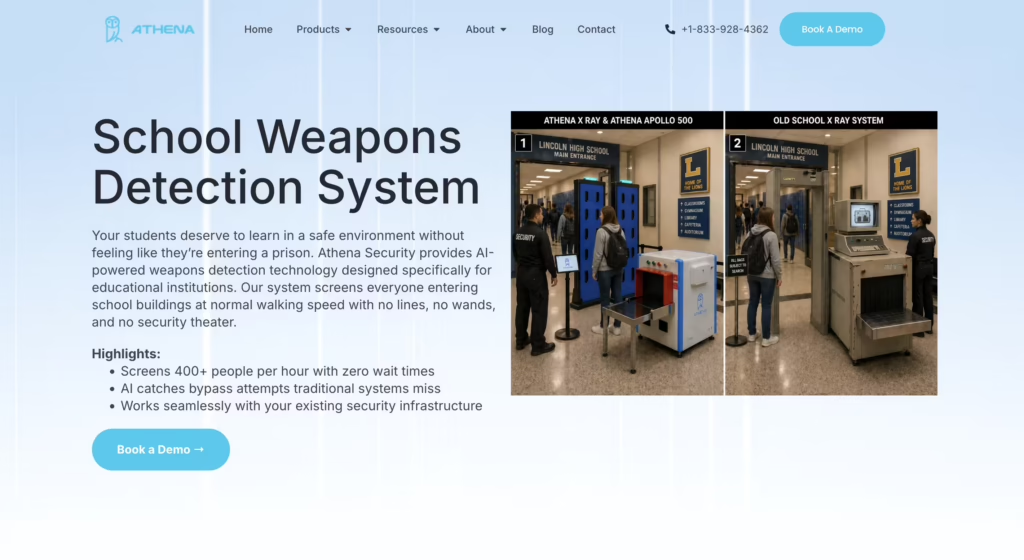
Athena Security helps schools build a layered screening workflow using our weapons detection system for K-12, AI X-ray baggage screening, secondary screening, staff training, and post-go-live support.
Apollo screens students for knives and small weapons carried on the person. The AI X-ray baggage scanner screens backpacks, lunch bags, sports bags, and other carried items. This separates person screening from bag screening, so schools do not have to rely on one system to do everything.
Athena’s AI X-ray baggage scanner also supports:
- iPad-based controls
- Three speed settings
- Fastest speed of 2,000 bags per hour
- Vape detection for schools and custom modifications
- Integrated WDS and X-ray workflow
- Secondary screening for shoes, boots, legs, and bags
- Staff training
- 24-hour service and support
Our systems have been deployed across several school districts, like Lamar Consolidated Independent School District (LCISD), Hosanna Christian Academy, and more.
If your school is figuring out how to prevent knives and small weapons from entering school, we can show you how systems work together in a real school workflow.
Book a demo using the button below or call us at +1-833-928-4362.

Frequently Asked Questions
Our experts have answered a few more questions to help you better understand what to look for and what to expect before choosing a solution for your school.
1. What Should I Look For In A Weapons Detection System For School?
Look for a weapons detection setup that can detect knives and small weapons on students, screen bags separately with an X-ray baggage scanner, keep students moving during arrival, and help staff respond quickly when there is an alert. The key things to check are detection capability, entry speed, X-ray bag screening, alert clarity, secondary screening, staffing needs, training, and demo proof.
Buying a weapon detection system for schools? Read this first.
2. I Don’t Have Enough Staff. What Should I Do?
If a school does not have enough security staff, it can use trained teachers or school staff to support the entrance flow during arrival as not every checkpoint role needs to be handled by a security officer.
The key is to break the workflow into simple tasks, such as:
- Guiding students before they reach the scanner
- Telling students to remove bags and get ready for X-ray screening
- Helping bags move off the X-ray tray quickly
- Directing students after they walk through the detection system
- Keeping the main line moving
The security officer should handle secondary screening. That person should know how to respond when Apollo or the X-ray scanner flags a student or bag.
For the other roles, schools can rotate trained teachers or staff members. For example, one teacher may help during arrival one week, and another teacher may take that position the next week. Each person should be trained on exactly what they can and cannot do.
This works best when each person has one clear job. A teacher should not be expected to run the entire checkpoint. But a teacher can guide students, move cleared bags, or direct traffic so bags do not stack up and slow down the X-ray lane.
3. Why Should Schools Avoid Lowering Detection Sensitivity For Speed?
Schools should not lower detection sensitivity just to reduce alerts because that can allow smaller weapons to pass through. Fast entry matters, especially during morning arrival. But a system that moves students quickly by reducing sensitivity may miss the very items the school wants to stop, such as small knives, razor blades, or other compact weapons.
If the system creates too many alerts, the better answer is a cleaner workflow:
- Use the weapons detection system to screen students.
- Use the X-ray baggage scanner to screen bags separately.
- Use secondary screening to resolve alerts away from the main line.
- Train staff to respond quickly and consistently.
This setup helps schools keep entry moving without turning down detection to a point where smaller weapons become easier to miss.
And to understand why schools need a weapons detection system and an X-ray scanner, read this article.
4. I’m considering Evolv eXpedite and Athena AI X-Ray Baggage Scanner. Which Is Better For Schools?
Evolv eXpedite may be a fit if your school mainly wants fast, autonomous bag screening with minimal operator involvement. Athena AI X-Ray Baggage Scanner is a stronger fit if your school needs to screen backpacks, lunch bags, sports bags, and daily school items for more than guns. Athena can help detect guns, knives, vapes, dense metal objects, and suspicious materials inside bags.
For a deeper breakdown, read our full comparison of Evolv eXpedite vs Athena AI X-Ray Baggage Scanner.
5. How Can I Buy the Athena WDS and AI X-Ray Baggage Scanner?
You can contact our team directly to discuss your specific needs and receive a customized quote. You can email us at [email protected] or call us at +1-866-592-3922.
If you’d like to see the system in action, you can request a free demo below.
Disclaimer: The images have been created using AI-based tools and are intended for illustrative purposes only. They may not accurately represent real individuals, locations, or situations. Any resemblance to real persons, living or dead, or actual events is purely coincidental.