
| Summary: To write a school safety grant application for a weapons detection system, you must first read the grant requirements carefully, conduct a safety assessment to collect evidence, and describe the WDS you want to implement. Then, draft a detailed implementation plan with stakeholder support, measurable outcomes, and sustainability. Finally, build and justify your budget. |
In 2023, the COPS (Community Oriented Policing Services) Office received 1,022 SVPP applications, but only 206 were funded. That’s just 20% of all applicants. Reviewers evaluated applications based on factors like safety assessment efforts, strength of the written narrative, demonstrated need for funding and security improvement, and sustainability plans.
This shows that your school safety grant application must build a compelling, evidence-backed narrative. It should explain why you need the funding, what equipment you plan to purchase, how it will address your security gaps, what it will cost, how you’ll implement it, and even maintain it after the grant ends.
In this article, we’ll discuss how to write a school safety grant application for a weapons detection system (WDS).
What Does a School Safety Grant Application for a Weapons Detection System Include
A school safety grant application for a weapons detection system includes the following components:
| Component | What to Cover |
| Project Summary | State your security concern, requested funding amount, WDS you plan to purchase, and the expected result. |
| Statement of Need | Highlight security gaps found during safety assessments and local crime/incident data to demonstrate why your school needs WDS. |
| Project Description | Explain which WDS you plan to buy, how many units you need, on which entrances you’ll deploy them, and how this aligns with your broader security programs. |
| Implementation Plan | Explain when and how you’ll procure, install, configure, test, deploy, and maintain the WDS. |
| Stakeholder & Community Support | Identify everyone involved in this project: school leaders, security staff, law enforcement, procurement teams, parents, or community partners. |
| Outcomes and Performance Evaluation | Define the results you expect and the metrics you’ll use to measure them. |
| Budget | Break down every expense the grant funds will be used for and justify it. |
| Sustainability Plan | Explain how you will operate, maintain, and fund the project after the grant ends. |
Based on the grant, some of these components might be combined or addressed under different sections. But at its core, your grant application should cover these aspects.
How to Write a School Safety Grant Application for a Weapons Detection System
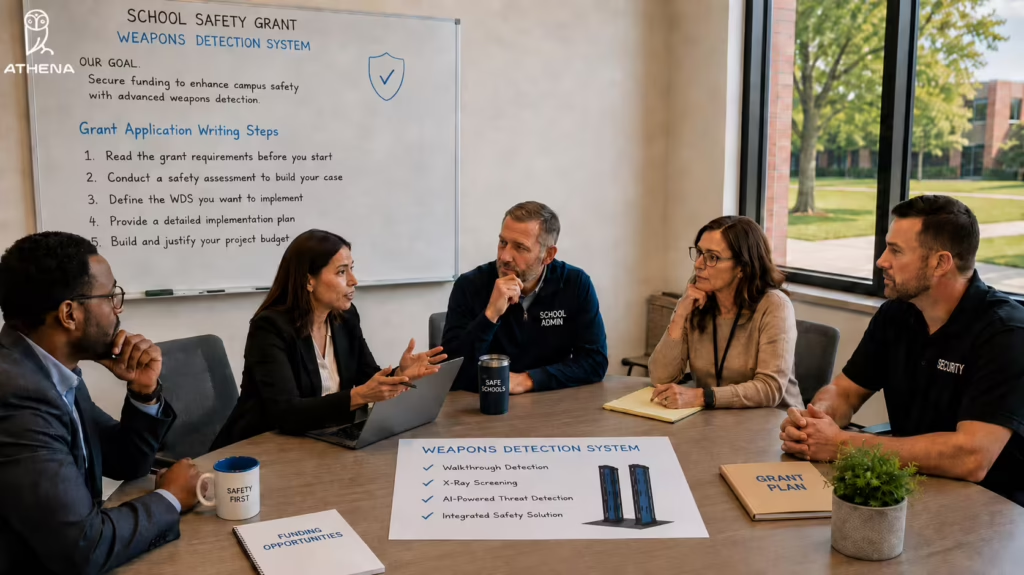
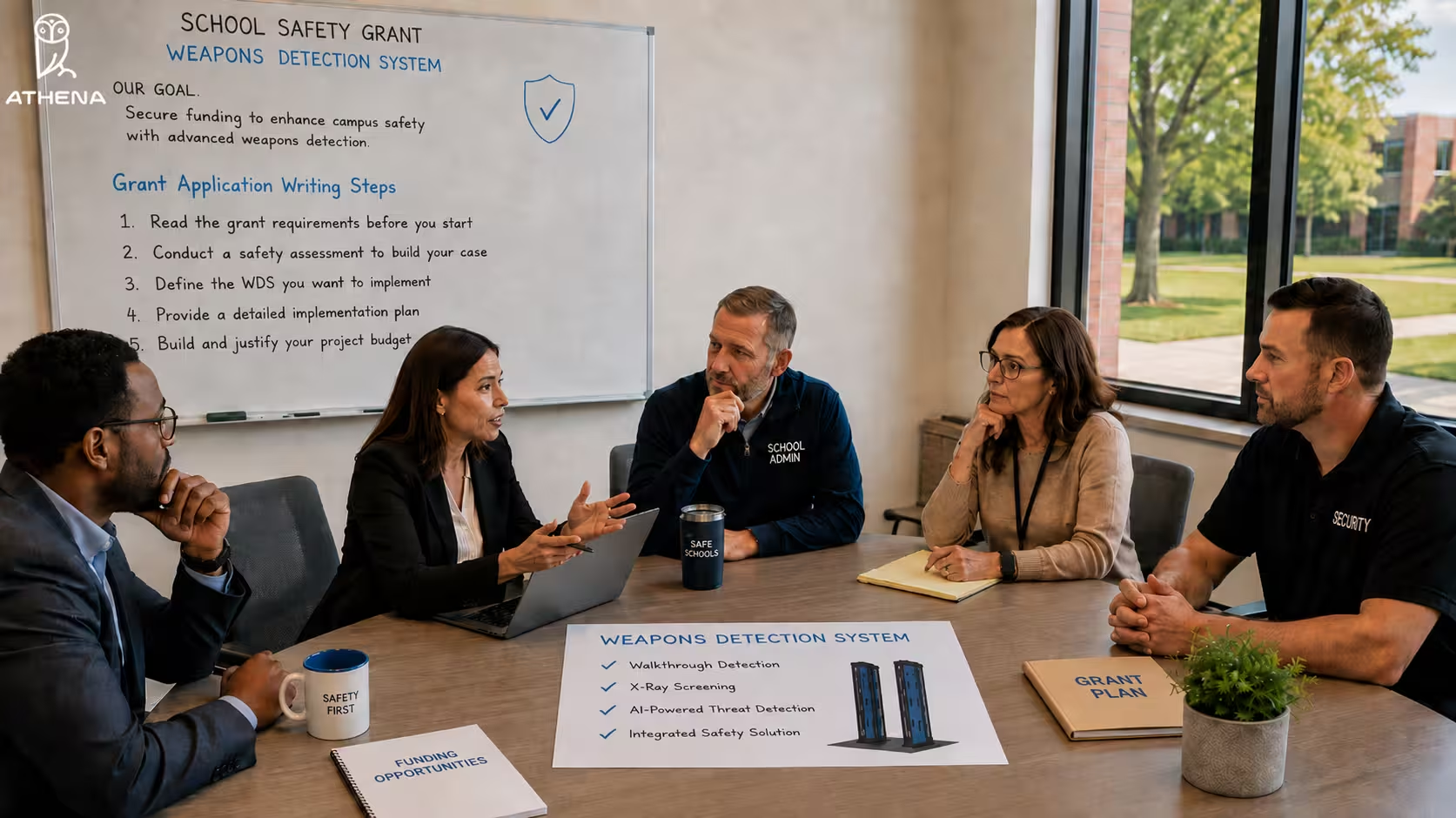
To write a school safety grant application for a weapons detection system, you must:
- Read the grant requirements before you start.
- Conduct a safety assessment to build your case.
- Define the WDS you want to implement.
- Provide a detailed implementation plan with stakeholder support, measurable outcomes, and a sustainability strategy.
- Build and justify your project budget.
Let’s discuss each step.
Step 1: Read the Grant Requirements Carefully Before You Start
Review the grant guidelines carefully to ensure your application meets the funder’s requirements:
- Confirm which hardware, staffing, and compliance costs the grant covers.
- Identify the factors reviewers use to evaluate applications.
- Note any required safety assessment, past incident data, crime statistics, or other supporting documentation.
- Identify required compliance protocols, like mandatory monthly superintendent sign-offs.
- Check formatting and writing guidelines. For example, the School Violence Prevention Program (SVPP) requires the application to be 2-8 pages long, with one-inch margins and 12-point Times New Roman.
Create a checklist of these requirements and use it to review your application before submitting it.
Step 2: Conduct a Safety Assessment to Build Your Case
A pre-grant safety assessment should cover:
- Physical and Digital Security: Evaluate district-wide security, the campus exterior perimeter, the building perimeter, classrooms/interior, and digital infrastructure. Document gaps like unscreened entrances, manual searches, or your existing detector’s inability to catch small-edged weapons.
- Traffic Logistics: Measure peak arrival volume and the percentage of students carrying bags/laptops.
- Staffing and Operational Needs: Calculate the security personnel and helpers needed to operate the proposed screening setup.
To learn more about calculating staffing needs, read our guide on how to screen a large number of students quickly for weapons.
Step 3: Define the WDS You Want to Implement
Your grant proposal should explain why the proposed WDS fits your school’s security needs. To achieve this, describe the detection technology, weapon signatures, throughput speed, integration capacity, data storage and privacy policies, and certifications.
For example, if you were requesting our concealed weapons detection system, you’d explain that it uses multi-sensor AI to analyze an object’s mass, shape, and density to detect firearms and small blades while filtering out harmless items.
Step 4: Provide a Detailed Implementation Plan with Stakeholder Support, Measurable Outcomes, and a Sustainability Strategy
To create a detailed implementation plan, break down the project into stages and answer these questions for each:
- Procurement: When and how will you purchase the equipment?
- Deployment: Which entrances will the WDS cover, and why did you prioritize them?
- Stakeholder Support: Who are the key stakeholders, and what are their roles?
- Staff Training: What training will you provide to security officers, helpers, school admins, etc.?
- Screening Procedures: How will the security team handle WDS alerts and secondary screening?
- Testing: How will you test and calibrate the system before it goes live?
- Measurable Outcomes: Which metric(s) will you track: screening throughput, types of weapons detected, reduction in secondary searches, or entrances covered?
- Maintenance and Sustainability: Who will review performance, schedule maintenance, manage compliance, and fund the deployment after the grant ends?
Add a timeline showing when each implementation stage will begin and end.
Step 5: Build and Justify Your Project Budget
Your project budget should account for three types of costs:
- Hardware Costs: Include the WDS, X-ray baggage scanners, secondary screening equipment, divestment tables, bins or trays for belongings, networking hardware, electrical work, signage, lane dividers, etc. Mention the cost per unit, how many units you require, and the total cost.
- Staffing Costs: Cover funding for staff needed to operate the primary and secondary screenings, manage entry lanes, and support implementation. Calculate staffing costs using the number of staff required, working hours, pay rates, and applicable benefits.
- Compliance Costs: Account for expenses related to training, certifications, audits, service fees, software licenses, etc.
For example, Oklahoma’s State Grant Program for School and Campus Safety and Security includes a budget narrative worksheet (check page 8) where applicants can list each expense, quantity, and total project cost.
| Note: Schools often neglect staffing when building their case for their WDS grant. So, check how the grant covers personnel costs and which staffing expenses are eligible to budget accordingly. |
How to Justify Your Budget
Here are some tips to justify and defend your required funding for a weapons detection system:
- Tie each expense to a safety gap identified during your assessment and explain how it supports the expected outcome.
- Compare recurring labor costs for manual screening with reduced staffing costs for automated/AI-powered screening.
- Highlight savings from screening technology that integrates with your existing X-ray units or walkthrough systems.
- Include relevant vendor case studies to show measurable results of using such technology.
Once you’ve prepared the application, review it against the funder’s requirements and attach all required quotes or supporting documents.
How Can Athena Security Help
If you plan to fund our AI-powered WDS through a school safety grant, our team can conduct a site assessment, evaluate your school’s entrances against DHS best practices, and determine the exact equipment needs. We also provide grant-writing support and grant-friendly quotes with a contingency clause, so you incur no cost if the grant is not awarded.
Book a demo below, or call +1-833-928-4362 to discuss your grant requirements.
Frequently Asked Questions About School Safety Grant Applications for WDS
While you prepare your school safety grant application, you might have a few questions. The FAQs below cover some common questions we’re asked about popular school safety grants, funding coverage, and AI usage.
1. What Are Some Common School Safety Grant Applications That Cover Weapons Detection Systems?
Several federal and state grant programs help fund school weapons detection systems:
- COPS School Violence Prevention Program (SVPP)
- STOP School Violence Program
- Nonprofit Security Grant Program (NSGP)
- State-specific grants like Indiana’s Secured School Safety Grant or Arkansas’ DESE School Safety Grant
Use this grant finder tool to find grant programs available to your K-12 school.
2. Will the School Safety Grant Cover All My WDS Expenses?
Not necessarily. Grants can have funding caps and restrictions on eligible expenses, so your school may need to cover part of the total cost.
For example, in April 2026, the Wilson County School Board approved the purchase of four mobile weapons detection systems costing nearly $440,000, which included $249,200 for the four units, $177,475.20 for annual software subscriptions, and $10,965.20 for a test kit and installation. The district had to pay only a little over $15,000, as state grants covered most of the expense.
Depending on the grant, schools or districts may have to cover expenses like:
- Ineligible screening equipment or technology
- Costs beyond the grant funding cap
- Required cost-sharing or matching funds
- Staffing expenses
- Divestment setups
So, always check which expenses the grant covers before applying and preparing your budget.
3. Should I Use AI to Write a School Safety Grant Application?
Yes, you can absolutely use AI to assist you, but you should treat it as a collaborative drafting partner rather than an automated author.
Disclaimer: The images have been created using AI-based tools and are intended for illustrative purposes only. They may not accurately represent real individuals, locations, or situations. Any resemblance to real persons, living or dead, or actual events is purely coincidental.