
In high-stakes security environments, performance must never compromise safety. Security X-ray systems play a critical role in threat detection across airports, courthouses, schools, and other public facilities, but they also introduce radiation and operational risks that must be carefully controlled to protect operators and the public.
Athena’s AI baggage X-Ray is engineered to meet and exceed regulatory safety requirements while addressing real-world operational challenges. Every safety feature is intentional, layered, and verified. Safety is not treated as an add-on, but as a core design principle embedded into the system architecture now powered with AI.
Radiation-emitting systems are required to provide visible warnings to operators and nearby personnel. Regulatory standards specify that radiation warning signage must be clearly displayed on all accessible sides of an X-ray unit to ensure awareness and hazard recognition (U.S. Food and Drug Administration, 2019).
Athena AI baggage X-Ray systems include high-visibility safety signage on each side of the unit, ensuring immediate awareness regardless of operator position or facility layout. This supports compliance while reinforcing best practices for situational awareness in active screening environments.
To protect operators and maintenance personnel, baggage X-ray systems must prevent radiation emission when internal components are accessible. Federal performance standards require that X-ray radiation automatically deactivate if any access panel is opened (U.S. Food and Drug Administration, 2019).
Athena enforces this requirement at the hardware level. If any panel is opened, X-ray emission immediately ceases. Radiation cannot operate while internal components are exposed, removing reliance on procedural memory or manual safeguards and reducing the risk of accidental exposure during servicing.
Regulations mandate that X-ray systems include an accessible emergency control capable of immediately disabling the radiation source. This requirement is intended to provide operators with direct and immediate intervention capability during unexpected events (ANSI/HPS, 2018).
Each Athena AI baggage X-Ray unit includes a clearly marked red emergency stop button. When activated, the system instantly shuts down all X-ray radiation. This direct physical control eliminates delays, menus, or ambiguity and provides operators with confidence when seconds matter.
To prevent unauthorized or improper use, X-ray systems must operate only under direct operator control. Regulatory standards specify that an operator key must be used to enable X-ray emission and that removing the key places the system into a safe standby state (ANSI/HPS, 2018).
Athena complies with this requirement through a physical key-controlled operation system. The X-ray cannot operate unless the key is engaged, and turning the key to standby immediately disables radiation output. This ensures accountability, authorized use, and proper shutdown when the operator leaves the station.
Radiation safety frameworks emphasize minimizing unnecessary exposure through system design rather than procedural dependence. Foundational principles of radiation protection include justification, optimization, and dose limitation, all of which aim to reduce risk to both operators and the public (National Council on Radiation Protection and Measurements, 2019).
Standards such as ANSI/HPS N43.17 establish maximum dose limits and performance requirements for security screening systems to ensure long-term safety in operational environments (ANSI/HPS, 2018). AI baggage X-Ray aligns with these principles by embedding protective measures directly into system architecture.
Every Athena AI baggage X-Ray system is delivered with oversight from a Radiation Safety Officer. Each unit undergoes inspection and testing to verify compliance with applicable radiation safety laws and performance standards prior to deployment.
This ensures organizations can deploy Athena with confidence, knowing the system meets regulatory requirements from day one without the need for additional verification or retrofitting.
Human factors such as fatigue, distraction, and long shifts are well-documented contributors to operational risk in security screening environments. Studies on vigilance and human attention demonstrate that sustained monitoring tasks are associated with declining performance over time, increasing the likelihood of missed hazards (Warm, Parasuraman, & Matthews, 2008).
Athena extends beyond baseline regulatory requirements with its AI-based Agent Operator Presence Check software. This system continuously monitors operator engagement, and if the operator is no longer present or attentive, X-ray radiation output automatically shuts off. This added safeguard helps ensure radiation is active only when a trained operator is actively supervising the system.
Academic research in X-ray imaging and automated threat detection has shown that intelligent detection systems improve accuracy and reduce operator cognitive load, particularly when screening dense or cluttered baggage environments (Zhang et al., 2024).
Athena incorporates intelligent detection logic that can automatically stop the conveyor belt when a suspected threat is identified inside the X-ray tunnel. This allows operators to assess the object while it remains fully within the imaging area, reducing rushed decisions, partial exposures, and downstream handling risk.
Athena AI baggage X-Ray integrates regulatory compliance with intelligent AI agent automation to protect people as effectively as it protects facilities. By combining physical controls, automatic shutdown mechanisms, AI-based operator monitoring, and intelligent belt management, Athena reduces operational risk in dynamic, high-pressure environments.
This is safety that is engineered, documented, and verified—built for the realities of modern security operations.
Athena’s AI-powered X-ray baggage scanner integrates with an Apple iPad to provide intuitive monitoring and control of the conveyor belt system. The Athena software allows officers to start and stop the belt, as well as view the current belt status in real time.
When the system detects a potential threat, the AI automatically triggers an alert and can stop the conveyor belt before the bag exits the scanner. This ensures that any item identified as a possible risk remains secured within the system, preventing unauthorized retrieval and enhancing overall security effectiveness.
The Athena app on the iPad provides operators with an intuitive way to interact with Baggage AI X-ray Machine in real time. Users can easily zoom, adjust colors, and enhance images using simple touch gestures—such as pinch-to-zoom—directly on the screen.
This modern interface replaces traditional keyboard-based controls found in legacy systems, which often require extensive training and multiple keystrokes to achieve the same result. With Athena, actions that once took several steps can now be completed instantly with natural gestures.
As a result, operators can work faster and more efficiently, allowing them to focus on broader security responsibilities. Training time is also significantly reduced—down to minutes—since most users are already familiar with iPad functionality, one of the most user-friendly devices available.
The Athena software includes both automated and manual testing processes to ensure the AI X-ray system is functioning properly. When the system is rebooted or a manual test is initiated, the operator is prompted to run a test piece through the scanner four times, one in each direction.
Each scan is automatically evaluated and documented as either a pass or fail. If the system successfully detects the test object, the scan is recorded as a pass. If the test piece is not detected, the system automatically records a failure.
In the event of a failure, Athena generates a detailed report explaining why the test did not pass and prompts the operator to document the corrective actions taken. This built-in process ensures accountability, consistent performance verification, and a clear audit trail for compliance and operational integrity.
When the Athena X-ray system is paired with the Apollo 500 Walk-Through Detection System (WDS), low-throughput environments can be efficiently managed by a single operator. Both systems are integrated into a unified interface, allowing alerts and controls to be monitored from one screen.
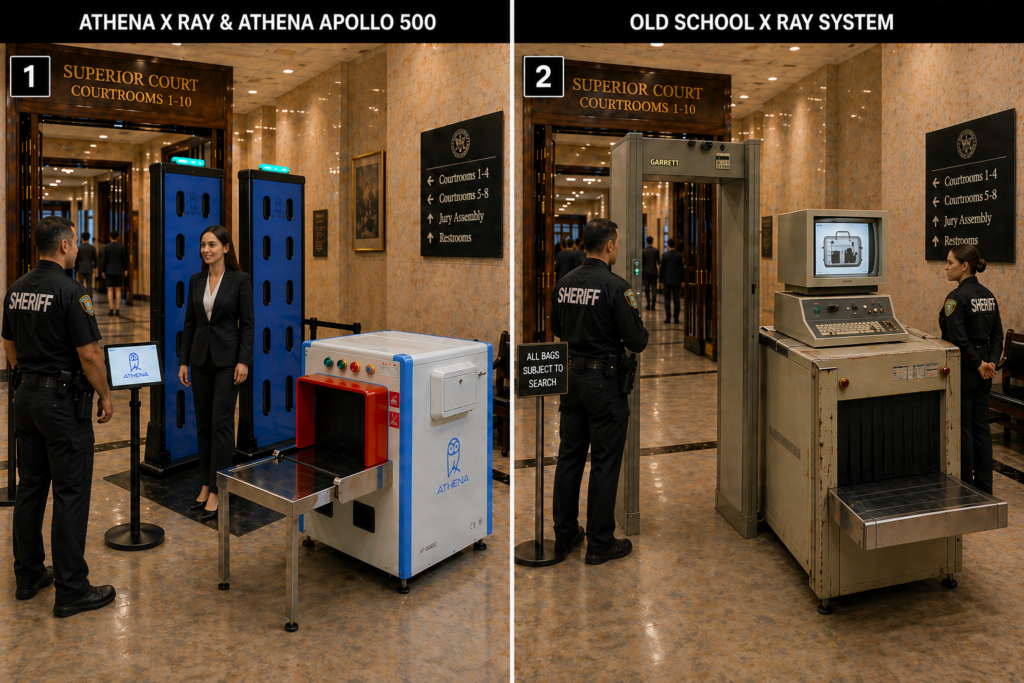
This setup enables the operator to oversee and manage both the X-ray scanner and the WDS from a single position—typically located at the exit end of the X-ray. The positioning allows the operator to face forward toward incoming traffic, maintaining visibility of the public while avoiding having their back turned, thereby improving both security awareness and operational efficiency.
Athena’s application has advanced AI modeling fully integrated into the platform, enabling real-time detection and analysis of 80+ objects within the X-ray system. The AI continuously learns and improves, helping identify potential threats with greater accuracy and consistency.
By embedding AI directly into the application, Athena enhances operator effectiveness through automated alerts, reduced reliance on manual interpretation, and faster decision-making. This not only improves security outcomes but also increases throughput and operational efficiency.
Additionally, the platform is designed to evolve as new AI capabilities are developed. For example, emerging features such as drone detection demonstrate how Athena can expand beyond traditional screening to address modern and evolving threats. This flexibility ensures the system remains future-ready, adapting to new security challenges as they arise.
Athena’s “Second Look” feature is designed for facilities operating multiple X-ray systems (typically three or more). This capability allows all cleared alerts from different machines to be routed to a centralized review station for additional screening.
Instead of requiring each operator to closely scrutinize every image under pressure, the system enables frontline staff to focus on primary screening while a dedicated reviewer monitors cleared alerts in a separate, controlled environment. This reduces operator fatigue and improves overall accuracy.
At the central station, the reviewer can quickly scan through images that were initially cleared by the AI and frontline operators. If everything appears normal, no action is required and operations continue uninterrupted. However, if the reviewer identifies a concern that may have been missed, the system can immediately notify the on-site operator to stop the belt and take appropriate action.
This approach creates a layered security model—combining AI detection, frontline screening, and centralized oversight—to improve threat detection while maintaining efficiency and reducing stress on individual operators.
References
ANSI/HPS. (2018). ANSI/HPS N43.17: Radiation Safety for Personnel Security Screening Systems Using X-Ray or Gamma Radiation. American National Standards Institute / Health Physics Society.
National Council on Radiation Protection and Measurements. (2019). Radiation Protection Principles and Practices. NCRP Report No. 180.
U.S. Food and Drug Administration. (2019). Compliance Guide for Cabinet X-Ray Systems. Center for Devices and Radiological Health.
Warm, J. S., Parasuraman, R., & Matthews, G. (2008). Vigilance requires hard mental work and is stressful. Human Factors, 50(3), 433–441.
Zhang, Y., Liu, H., Chen, X., & Wang, S. (2024). Automated object detection for security X-ray imaging under occlusion conditions. Journal of Computational Design and Engineering.