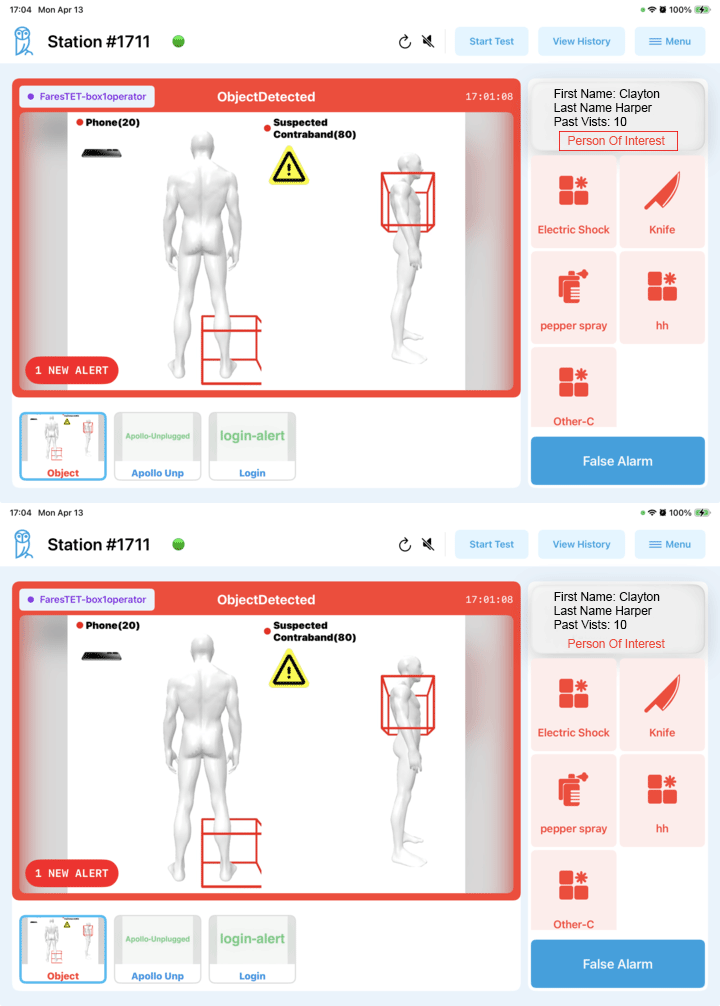

In today’s security landscape, organizations—especially hospitals—are moving beyond standalone systems and toward integrated security ecosystems. While weapons detection systems (WDS) and visitor management systems for hospitals
(VMS) each provide value independently, their true power emerges when they operate together.
By combining detection with identity and intent, organizations can move from isolated alerts to real-time security intelligence—giving officers the information they need, exactly when they need it.
The Problem: Security Without Context
Weapons detection systems are highly effective at identifying potential threats. However, on their own, they answer only one question: “Is there a potential weapon?”
What they don’t answer is who the individual is, why they are there, whether they are expected or authorized, and whether the situation is high-risk or manageable.
Without this context, security officers are forced to manually verify information, check multiple systems, and make decisions with incomplete data. This slows response time and increases uncertainty—especially in high-pressure environments like hospitals, emergency departments, and ambulance bays.
The Solution: Integrated Security Systems
When Athena’s visitor management systems for hospitals are combined with Concealed weapons detection system, the result is a connected, continuously learning security environment.
Inside the system, this operates as a closed-loop network where detection events trigger data sharing across systems, visitor data is automatically attached to alerts, additional context is added in real time, and outcomes feed back into the system for continuous improvement.
Instead of disconnected tools, security becomes a coordinated intelligence system.
How Athena’s Visitor Management Enhances Weapons Detection
1. Identity + Detection = Immediate Context
Athena’s visitor management system provides name and identity (if registered), purpose of visit, approved access areas, and time of entry. When a detection event occurs, this information is instantly linked.
Instead of “unknown individual with possible weapon,” security teams see a registered visitor with context, such as being present for an ER visit but flagged for a potential item. This drastically improves decision-making.
2. Faster Response Without Interrupting Operations
Speed matters—but so does workflow.
A combined system allows instant alerts with enriched data, eliminates the need for officers to switch between platforms, and avoids delays for patients, visitors, or staff. This is especially critical in emergency departments, high-traffic hospital entrances, and ambulance bays where workflows cannot be interrupted.
Security teams gain speed and clarity without creating bottlenecks.
3. Reduced Cognitive Load for Security Officers
Security teams often operate under pressure.
Without integration, officers juggle multiple systems, manually piece together information, and experience communication delays. With integration, all relevant data appears in one interface, alerts are prioritized and contextualized, and decision-making becomes faster and more confident.
The result is less stress, fewer errors, and better outcomes.
The Power of Real-Time Data Enrichment From Athena
A major advantage of combining Athena’s WDS and VMS is real-time data enrichment.
As soon as a detection occurs, visitor data is attached, location data is confirmed, historical patterns (if available) can be referenced, and alerts are distributed to the right personnel. This happens automatically, without requiring additional steps from officers.
What a Fully Integrated Security Ecosystem Looks Like
A modern security environment connects weapons detection systems, visitor management systems, video surveillance, access control, and alert and communication platforms.
Together, these systems form a closed-loop network that continuously shares data, improves over time, and provides complete situational awareness.
From Alerts to Intelligence is Athena’s vision
The shift from standalone systems to integrated networks represents a fundamental transformation. Traditional security produces isolated alerts that require manual verification and slow response. Integrated systems provide context-rich intelligence, automate data enrichment, and enable real-time decision-making.
Instead of reacting to fragmented information, security teams operate with a complete, unified picture of each situation.
Conclusion
Athena’s Weapons detection systems is a critical step forward in modern security—but their full potential is only realized when paired with Athena’s visitor management systems for hospitals.
By combining detection with identity and intent, organizations can improve response times, reduce uncertainty, enhance safety without disrupting operations, and empower security teams with better information.
In an environment where every second matters, more information—delivered instantly—makes all the difference.
FAQ’s
1. What is Athena’s visitor management system (VMS) in security?
Athena’s visitor management system tracks and manages visitor identity, purpose, and access within a facility, providing critical context during security events.
2. How does Athena’s VMS work with Athena’s weapons detection systems?
Athena’s VMS integrates with Athena’s weapons detection systems to attach identity and visit data to detection alerts, giving security teams more context in real time.
3. Why is combining VMS and weapons detection important?
It allows organizations to move from simple detection to informed decision-making, improving response time and reducing uncertainty.
4. What is a closed-loop security network?
A closed-loop network is an integrated system where detection, identity, and response data continuously flow between systems, improving security intelligence over time with out depending of the internet.
5. Does integration slow down security operations?
No. Integration actually speeds up operations by automating data sharing and reducing manual work for security officers.
6. How does this help in hospitals?
Hospitals benefit from faster response times, improved safety, and the ability to maintain patient flow while enhancing security.
7. What are the main benefits for security teams?
Faster decision-making, better situational awareness, reduced workload, and more accurate responses.